


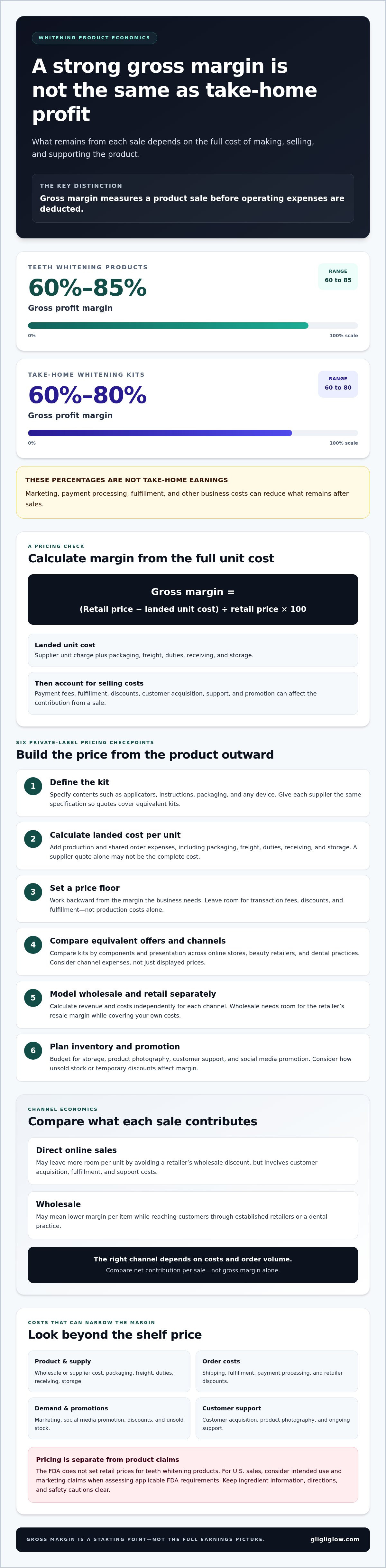
Teeth whitening products can show gross profit margins of 60% to 85%, while take-home kits are often in the 60% to 80% range. But those figures aren’t take-home earnings: the profit margins on teeth whitening products depend on what each kit costs, its retail price, and the operating expenses left after sales. A healthy-looking margin can shrink once marketing, payment processing, and other business costs are included.
It’s natural to focus on the sale price, but profit margins on teeth whitening products depend on what remains after the costs of making and selling each product. This guide explains how to calculate gross margin, compare kit costs with retail prices, and account for operating expenses that shape potential earnings. You’ll also see how repeat purchases, product mix, and sales channels affect the numbers, so you can build a pricing approach around your business instead of relying on a headline percentage.
Key Takeaways
- Separate gross margin from net profit so you can see what remains after operating expenses.
- Set retail prices by weighing product format, sales channel, and the costs of bringing each item to customers.
- Compare private-label production options by looking beyond the unit cost to packaging, fulfillment, and other expenses.
- Build a realistic earnings picture by accounting for marketing, equipment, payment processing, and repeat purchases.
- Use the right mix of kits, refills, pens, and devices to shape an offer that fits your customers and business model.
Pricing structures for whitening products
Price each product by its full cost and sales channel, not by shelf price alone. These steps connect customer demand and product positioning with the margin left after each sale.
-
Review Wholesale Costs and Margins
Start with your wholesale cost per unit, then add packaging, shipping, payment fees, and expected costs from unsold stock. Compare the full cost with your planned selling price to see the gross margin each sale can contribute. Wholesale orders can bring volume, but offering retailers a discount may reduce your margin per unit. Set terms that leave room to cover your business expenses.
-
Set Over-the-Counter Product Prices
Choose a price tier that reflects the product format, presentation, and customer’s reason for buying. A simple whitening product may compete on accessibility, while a kit with several components needs clear value cues. Compare similar products at the same type of retailer, then check whether your margin holds after fulfilment costs and promotions. Avoid automatic discounting, since frequent markdowns can reset customer expectations.
-
Compare Competitor Pricing
Review comparable offers across beauty retailers, dental practices, and online stores. Compare format, included components, directions, and customer support, not just the displayed price. Note how entry-level products are positioned against premium kits, then decide where your offer fits. Demand and local buying habits can affect the right price, so revisit your comparison when your sales mix changes.
-
Choose Channels With Margin in Mind
Direct online sales can leave more room per unit because you avoid a retailer’s wholesale discount, but you take on customer acquisition, fulfilment, and support costs. Wholesale may bring lower margins per item while reaching customers through established retailers or a dental practice. The most profitable channel depends on costs and order volume. Compare net contribution per sale, not gross margin alone.
-
Account for FDA Requirements
The FDA does not set retail prices for teeth whitening products. For U.S. sales, consider the product’s intended use and marketing claims when assessing applicable FDA requirements. Keep pricing and promotional copy separate from claims about treatment outcomes. Product positioning can affect how customers understand its purpose, so review the language on packaging, product pages, and advertisements.
-
Build Safety and Labeling Into the Offer
Make ingredient information, directions, and safety cautions clear on product labels and sales pages. Aggressive whitening treatments can alter enamel and increase susceptibility to demineralization, according to the National Library of Medicine. Avoid presenting whitening as risk-free or encouraging use beyond the directions. Clear information supports informed purchasing and helps customers distinguish at-home products from whitening services.
Private-label whitening kit costs and retail prices
Use these six steps to set a private-label price based on supplier costs, sales channels, and customer value. Keep product costs separate from the expenses of promoting and fulfilling each order.
- Define the kit before requesting quotes. List its contents, such as applicators, instructions, packaging, and any device. Send the same specification to each supplier so the quotes cover equivalent kits. Ask which components, labels, and packaging are included. A lower quote may reflect a different kit configuration, making a direct price comparison misleading.
- Calculate the landed cost per unit. Add the supplier’s unit charge to packaging, freight, duties, receiving, and storage costs. Divide shared order expenses by the number of units in the order. Separate production costs from shipping and storage instead of treating the supplier quote as the complete cost. This gives you a more useful starting point for pricing.
- Set a price floor with a margin formula. Use gross margin = (retail price minus landed unit cost) divided by retail price, then multiply by 100. Work backward from the margin your business needs, rather than marking up the supplier quote alone. Keep room for transaction fees, discounts, and fulfillment. A retail price that only covers production may leave too little to support selling the kit.
- Compare the same format across sales channels. Review comparable kits sold online, through beauty retailers, and in dental practices. Match products by components and presentation, not just by their cosmetic purpose. Direct sales may avoid a retailer’s wholesale discount, while retailer orders can involve different handling and promotional costs. Compare contribution after channel expenses before choosing a retail price.
- Model wholesale and retail as separate offers. Calculate revenue and costs independently for each channel. A wholesale price must leave room for the retailer’s resale margin while covering your landed costs and operating expenses. Test the calculation with a sample order: record units sold, discounts applied, and costs charged to that order. This helps show whether a volume deal can support profit.
- Plan inventory and promotion before launch. Include storage, product photography, customer support, and social media promotion in your operating budget. Estimate how unsold stock or a temporary discount affects margin, then set promotion limits. Keep product descriptions clear and consistent across channels, and avoid claims that your labelling and product information cannot support.
Teeth whitening business profitability
Take-home whitening kits can have gross margins of 60% to 80%, while in-office professional whitening services can have margins around 50% to 70%. The wider reported range for teeth whitening products and businesses is 60% to 85%. These are gross margins, not net earnings after operating expenses.
- Separate product and service margins. Compare like with like: a kit sale has different costs from an in-office treatment. Product margins may look higher before expenses, while services also involve labour, equipment, and appointment time. For a teeth whitening business, record each revenue stream separately. This makes it easier to see which offer contributes more after direct costs.
- Calculate net contribution for each sale. Start with the customer’s payment, then subtract product cost, packaging, fulfilment, payment fees, and promotion tied to that sale. For professional teeth whitening, include consumables, staff time, and room or travel costs. Gross margin is a useful starting point, but this calculation shows what remains to support rent, software, and other overhead.
- Model appointment capacity realistically. A service’s revenue depends on how many appointments you can complete and how long each one takes. Account for setup, cleaning, customer intake, and gaps between bookings, not just treatment time. Estimate revenue using appointments you can realistically serve. A full calendar can still produce weak profit if labour and operating costs absorb too much.
- Build repeat purchases into your forecast. Customers may buy take-home kits every couple of months. Track whether buyers return for replacement kits, refills, or touch-ups, and base projections only on observed repeat orders. A salon or retailer may provide another route to customers, but wholesale terms and fulfilment costs affect each order’s contribution.
- Track customer acquisition by channel. Record marketing spend alongside sales from online campaigns, retail displays, and referrals. If one channel attracts customers at a lower cost, compare its net contribution, not just its sales total. Include discounts in the calculation. A promotion can increase orders but reduce profit if the lower price no longer covers variable costs.
- Review performance on a consistent schedule. Compare actual sales, direct costs, and overhead with your forecast each month. Separate whitening kits from services, then identify changes in average order value, repeat purchases, and labour costs. Use the results to adjust product mix, pricing, or marketing. This helps show whether growth is adding profit or simply adding work.
Factors affecting actual profit margins
Use these steps to identify which costs reduce the money left from each sale. Compare product, channel, and operating expenses separately.
- Separate fixed and variable expenses. Record the cost of each product, then list recurring expenses such as storage, software, and insurance. Add costs that change with sales, including packaging and payment processing. For example, a discount reduces revenue per order, while a monthly software bill affects overall profitability. Separating these categories shows what each sale needs to contribute.
- Budget for equipment before launch. Add equipment costs to your startup budget rather than treating them as free once sales begin. Estimate how those expenses will be spread across expected sales. A small operation with limited equipment has a different cost structure from one built around frequent appointments.
- Match mobile investment to your business model. Identify whether your plan requires a basic mobile launch or a dedicated vehicle before forecasting costs. These different setups have different cost structures.
- Give marketing its own line in the budget. Include content creation, promotions, and social media spending in your selling costs. Compare each channel’s expenses with the sales it brings. A campaign without tracked conversions can increase costs while leaving you unsure which promotion supports profitable orders.
- Account for product mix and customer needs. Customers seeking a simple at-home product may choose differently from those looking for a kit or professional service. Track sales by format and include related fulfilment or support work. Sensitivity concerns can also affect product selection and customer questions. Clear product information helps customers choose appropriately and can reduce avoidable support demands.
- Measure inventory risk. Unsold kits tie up cash and may require storage or later discounts. Track stock by product type and compare orders with actual sales before placing another supplier order. If one format sells slowly, a larger purchase can increase holding costs. A smaller replenishment order may protect cash, even if its unit economics differ.
- Include labour and appointment capacity. For whitening services, record preparation, customer guidance, cleanup, and the appointment itself. Treatment time alone doesn’t capture the full labour cost. A mobile operator should also include travel and setup time for each visit. Compare revenue per appointment with these working hours to see whether the schedule supports the margin.
- Review actual results before expanding. Compare monthly sales with product costs, marketing, equipment, and fulfilment. If a new location or mobile setup adds fixed expenses, calculate how those costs change your break-even point. Base forecasts on recorded sales, not hoped-for demand. This review helps show whether adding products, appointments, or a vehicle improves profit or simply increases workload.
How much does it cost to manufacture teeth whitening strips, gels, and kits?
Estimate each format separately: strips, gel, and complete kits have different components and production needs. Use these steps to build a realistic unit-cost estimate before setting a retail price.
- Start with a private-label kit benchmark. Treat this as a starting point for product costs, not the full cost of selling a unit. Components and packaging affect the quote, while shipping, storage, and order handling add costs beyond manufacturing.
- Specify the kit contents before comparing quotes. Write down what the kit contains, including gel, applicators, trays, strips, or a device. Ask suppliers to quote the same configuration and packaging. A quote for gel and strips alone isn’t comparable with one for a complete kit. Matching specifications shows whether a lower unit cost reflects a different product.
- Price strips by their production components. Identify the strip material, gel formulation, individual packaging, and instructions required for each unit. Each choice can affect material use and assembly. Request a quote based on a defined product specification, then calculate the cost per sellable pack. Include damaged or unusable units in your costing rather than assuming every pack produced can be sold.
- Cost gels by package and intended use. List the gel container, applicator, closure, label, and outer packaging. For service-based use, consumables for one teeth-whitening session typically cost from single digits to the low teens. That figure describes session consumables, not the manufacturing cost of a retail gel product. Keep those cost categories distinct in your records.
- Calculate the landed unit cost. Add the quoted product cost to freight, packaging, receiving, and storage expenses. Divide shared charges across the units in the order. For example, if an order includes kits and refills, allocate shared shipping consistently. This gives you a clearer per-unit figure for comparing formats and setting wholesale or direct retail prices.
- Test the economics at different order sizes. Ask suppliers how order quantity affects unit costs, minimum order commitments, and inventory exposure. A larger production run may lower the quoted unit cost, but it also ties up more cash in stock. Compare the savings with storage, cash flow, and expected sales before committing to a larger batch.
- Build costs into your pricing model. Use the landed cost, channel fees, and fulfillment expenses to calculate what remains from each sale. Keep the manufacturing estimate separate from marketing and general operating costs. For a closer look at ready-to-use at-home formats, explore teeth whitening product options.
GLI GLI: GLI GLI Teeth Whitening Kit
GLI GLI Teeth Whitening Kit offers an at-home option for customers considering whitening products. If you’re assessing product formats for a retail assortment, GLI GLI Teeth Whitening Gel Refills, GLI GLI Teeth Whitening Pen, and GLI GLI LED Whitening Device provide additional categories to consider. Compare each format’s role in your range, then use your own wholesale costs, selling expenses, and retail strategy to assess its fit. For individual customers, these products connect at-home whitening with a personal oral-care routine. For dental professionals and retailers, wholesale opportunities offer a way to explore products for their businesses. The right next step depends on whether you’re choosing an at-home product or assessing a retail assortment. Visit gligliglow.com to explore GLI GLI’s offerings.
Make your next pricing move with confidence
Treat your next pricing decision as a chance to learn, not a permanent commitment. Choose one product or sales channel, set a clear goal, and review how customers respond before making broader changes. This steady approach helps you adapt your offer to real buying patterns instead of assumptions. Strong profit margins on teeth whitening products come from decisions that keep pace with your business and customers.
If you’re exploring products for your own routine or retail range, GLI GLI offers the GLI GLI Teeth Whitening Kit, GLI GLI Teeth Whitening Gel Refills, and GLI GLI Teeth Whitening Pen. Consider how each could fit your plans, then take the next step when you’re ready.
Contact GLI GLI to discuss your options. Keep learning, make thoughtful adjustments, and move forward with confidence.
Frequently Asked Questions
How Much Money Can You Make?
Revenue depends on sales volume, product mix, and whether you sell products or provide services. For an in-office example, three appointments daily at $150 each generate $450 in daily revenue, before expenses. That isn’t take-home profit. For a product business, estimate earnings by multiplying units sold by each unit’s contribution after direct costs, then subtracting overhead and marketing.
What are typical gross profit margins on teeth whitening products?
Gross margins for whitening products and businesses are commonly estimated at 60% to 85%, with take-home kits at 60% to 80%. These figures describe revenue remaining after direct product costs, not money left after running the business. To interpret a margin, use the same cost basis across products. Include product and packaging costs, then compare channels separately before judging which offer performs best.
What are typical net profit margins for teeth whitening brands and retailers?
Net profit depends on expenses beyond product costs, so use your own sales records to calculate it. Start with revenue, subtract direct costs, then deduct operating expenses such as marketing, storage, labour, and payment processing. A retailer with strong gross margins can still retain less if paid promotion or unsold inventory consumes the difference. Track net results by channel to guide decisions.
What are the biggest costs affecting teeth whitening product profitability?
The main cost pressures usually include product sourcing, packaging, shipping, customer acquisition, fulfilment, and unsold stock. Their effect varies by business model: a retailer may carry inventory and storage costs, while a service business also accounts for labour and appointment operations. Sort expenses into per-sale and ongoing categories, then review which costs rise as sales grow. This points to the most useful areas for cost control.
How do Amazon fees, retailer markups, and customer acquisition costs affect margins?
Each expense reduces the amount retained from a sale, but its impact depends on your product price and channel terms. Marketplace fees reduce proceeds per order; retailer markups mean wholesale pricing must leave room for resale; advertising adds acquisition costs. Compare channels using net contribution per unit after all three are included. For Amazon, use the fee schedule for your product category and fulfilment method in your calculation.


