


What if the best way to whiten your teeth without trays is to choose a product designed for a different application method? If trays feel bulky or inconvenient, learning how to whiten teeth without trays can help you compare options that fit your routine. But don’t assume every whitening gel can be brushed straight onto your teeth. The product’s own directions determine how it should be applied.
It makes sense to want a brighter smile without discomfort or guesswork. Whitening strips, pens and toothpaste use different approaches, and none is automatically right for every smile. Sensitivity, gum irritation and uneven results are also worth keeping in mind.
This guide compares common tray-free options, explains how to use them carefully and helps you choose based on comfort and convenience. You’ll also learn when to pause whitening and seek dental advice, so your smile-care routine feels more confident and less uncertain.
Key Takeaways
- Learn how to whiten teeth without trays by choosing a method made for its intended application, rather than using whitening gel in an unapproved way.
- Compare strips, whitening pens, toothpaste and dentist-supervised options to find a format that suits your routine and priorities.
- Set realistic expectations: whitening toothpaste mainly targets surface stains, while other methods have different limitations and routines.
- Use any whitening product according to its directions, and know when to stop if discomfort or irritation occurs.
- The Sparkle Booster Teeth Whitening Kit includes an LED device, a protective case, two 5 ml PAP gel syringes and a 2 ml Remineralization Pen.
Why whiten teeth without trays? Start with comfort, convenience, and realistic expectations
A whitening tray can work well for some people, but it may feel bulky, take extra time to fit into a routine or simply be a format you’d rather skip. Wanting a more comfortable or portable option is reasonable. The key is choosing a product made for the way you plan to use it, rather than improvising with a formula designed for a tray.
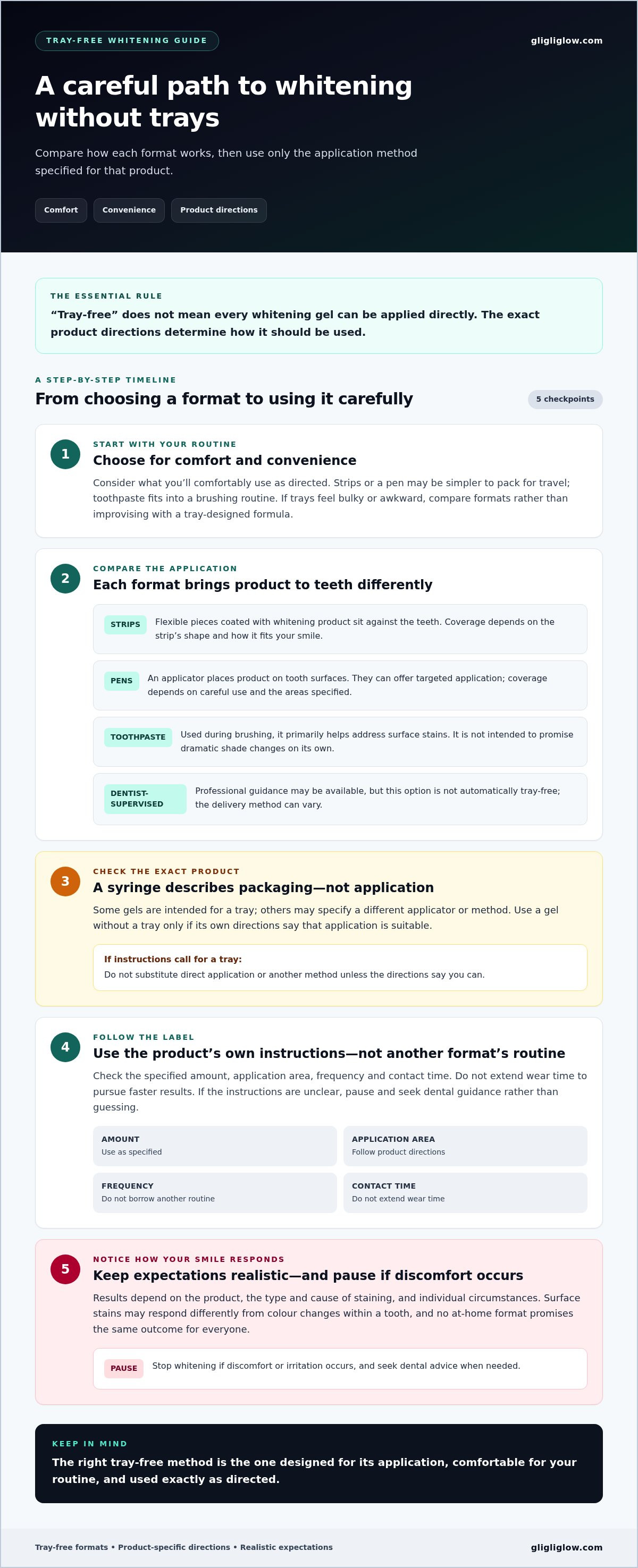
Here, “tray-free” means whitening methods that don’t rely on a tooth-shaped whitening tray to hold product against your teeth. It doesn’t mean every gel can be applied directly. Product directions explain where and how to use a formula, how long it stays in contact and whether it requires a particular applicator or device.
What does whitening without trays mean?
Tray-free options can include adhesive whitening strips, paint-on products or pens, and whitening toothpaste. Each works differently: strips sit against the teeth, pens and paint-on products apply formula with an applicator, and toothpaste is used during normal brushing. Products also differ in ingredients, contact time and instructions, so don’t copy one method’s routine for another. Dentist-supervised whitening may provide professional guidance, but it isn’t automatically tray-free; the delivery method can vary.
Tooth whitening can involve chemical processes that lighten tooth colour. At-home formats such as strips and gels use different ways to bring whitening ingredients into contact with teeth. That context doesn’t make products interchangeable. A tray-free method isn’t automatically suitable for every gel. If a product’s instructions call for a tray, don’t substitute direct application or another method unless the directions say you can.
Why might someone prefer a tray-free method?
Comfort and convenience are common reasons. Strips or a pen may be simpler to pack for travel, while toothpaste fits naturally into an existing brushing routine. Some people dislike wearing a tray or find it awkward to keep one in place. The best fit is personal: consider what you’ll comfortably use as directed, not just what seems quickest.
A missing or damaged tray can also disrupt a routine. That’s a practical frustration, not evidence that the gel is safe to use without it. Read the product instructions before continuing, and don’t guess at the amount or contact time. The question isn’t just how to whiten teeth without trays; it’s which product is intended for the application you prefer.
Keep expectations grounded. Results depend on the product, the type and cause of staining, and individual circumstances. Surface stains may respond differently from colour changes within a tooth, and no at-home format can promise the same outcome for everyone. Choose for comfort and routine, follow the directions and give your smile time to show how it responds.
How to whiten teeth without trays: understand what each method does
Tray-free whitening isn’t one single technique. Each format brings its formula into contact with teeth differently, so the best choice depends on the product’s design and directions. A strip, pen, toothpaste and gel syringe aren’t interchangeable just because they’re all related to whitening. For a broader look at choosing an at-home approach, explore this at-home teeth whitening kit guide.
How do strips, pens, and paint-on products differ?
Whitening strips are flexible pieces coated with whitening product. They’re placed over the teeth, so coverage depends on the strip’s shape and how it fits your smile. Pens and paint-on products use an applicator to place product on tooth surfaces. They can be convenient for targeted application, but coverage depends on careful application and which areas the directions specify.
Toothpaste takes a different route. Whitening toothpastes are used during brushing and primarily help address surface stains. They fit easily into a daily routine, but don’t expect toothpaste alone to deliver dramatic shade changes. Its purpose and application differ from products designed to stay in contact with teeth for a set period.
Formats vary in ease of use and coverage. Strips may cover several teeth at once; an applicator offers more control over placement; toothpaste is part of brushing. None guarantees an even result for every smile. Read the product label for the correct amount, application area, frequency and contact time. Don’t borrow directions from another format or extend wear time in pursuit of faster results.
Can whitening gel be used without a tray?
Only if the gel’s own directions say it’s suitable for that kind of application. The fact that gel comes in a syringe describes its packaging, not how it should be used. Some gels are intended to be placed in a tray, while other products may specify a different applicator or method. Follow the instructions for the exact product you have.
Never assume tray-only gel is safe or effective when spread directly onto teeth. Without its intended method, the amount, placement and contact with teeth or gums may differ from what the product directions are based on. If the instructions don’t clearly explain how to use the gel, pause and seek dental guidance rather than guessing.
That’s the practical answer to how to whiten teeth without trays: choose a product designed for the application you want, then follow its directions precisely. If you’re comparing formats, you can also explore at-home whitening options and read how each product is intended to be used.
Tray-free teeth whitening compared: which option fits your priorities?
The best fit depends on what you want from the routine: a format you can carry, a step that slots into brushing or professional guidance. This comparison can help you decide how to whiten teeth without trays without treating every method as interchangeable. Check the specific product directions too, since application, timing and frequency vary.
| Method | Tray needed? | Typical routine | Key limitation |
|---|---|---|---|
| Whitening strips | Usually no | Place the strip over teeth as directed, then remove it at the stated time. | Fit and coverage depend on the strip’s shape and your teeth. |
| Pen or paint-on product | Not usually, follow its label | Use the applicator to place product on the specified areas. | Even application takes care, and formulas aren’t automatically interchangeable. |
| Whitening toothpaste | No | Use during regular brushing according to the label. | Primarily addresses surface stains; it may not change deeper tooth colour. |
| Dentist-supervised whitening | Depends on the method | A dentist guides the approach and explains its use. | The format and routine depend on the treatment selected. |
Which method suits a busy or travel-focused routine?
Think about what you’ll need to carry and prepare. Strips come in individual pieces; a pen uses an applicator, while toothpaste fits an existing brushing routine. A pen or compact device may appeal if portability is a priority, but consider the steps involved. A device might come with parts or charging needs, so portability doesn’t necessarily mean it’s ready to use anywhere.
Before packing any whitening product, read its label for storage, timing and frequency instructions. A busy schedule isn’t a reason to extend contact time or double up on uses. Choose the format whose steps you can follow consistently.
Which option should sensitive-tooth users consider?
No whitening format can be assumed to prevent sensitivity. Review the directions and ingredient information, and avoid using a product more often or for longer than instructed. If sensitivity is persistent, worsening or present before you start, pause whitening and seek dental advice. For more help weighing your options, see this sensitive whitening strips guide.
The Sparkle Booster Teeth Whitening Kit includes a 2 ml Remineralization Pen. That’s a component of the kit, not a promise that the pen treats or prevents sensitivity. You can explore at-home whitening products and compare each item’s directions with the routine you’re comfortable following.
How to use a tray-free whitening product more carefully
A careful routine starts with the directions, not a guess. Whitening strips, pens, paint-on formulas, toothpastes and devices can have different instructions, so there’s no universal amount of gel or contact time that suits them all. Use whitening products according to their own directions. More product, longer wear or extra sessions don’t guarantee a brighter result and may increase the chance of irritation.
Before applying any tray-free whitening product
- Read the full instructions. Review the application steps, ingredient list, warnings, contact time and frequency limit. Don’t rely on directions for a different brand or product type.
- Check your teeth and gums. If your mouth is already irritated or you have concerns about your teeth or gums, pause and seek dental advice before whitening.
- Prepare only as directed. Follow the product’s stated preparation steps. Use only the specified amount, and apply it only with the method and to the surfaces the instructions identify. Don’t transfer tray gel to a pen, brush or finger for direct application.
This matters when you’re working out how to whiten teeth without trays: a syringe or tube doesn’t reveal whether a formula is intended for direct contact. The product directions do. Use GLI GLI products according to the instructions for the specific product, with no more than one use per day.
During and after use: what to watch for
- Follow the stated contact time. Keep the product on the intended surfaces and remove or rinse it as directed. Don’t leave it on longer to try to speed up results.
- Don’t stack whitening routines. Avoid combining products or increasing their frequency unless a dental professional advises you to. Using a strip and gel together, for example, may add exposure that neither product’s directions call for.
- Stop if something feels wrong. Significant irritation, unexpected discomfort or an unusual reaction is a reason to stop using the product. Don’t try to push through it or immediately switch to another whitening formula.
If pain continues after you stop, or you notice ongoing gum concerns or an unusual reaction, seek dental advice before restarting. Be ready to explain which product you used and how you applied it. Clear details can help a dental professional understand what happened and advise you on next steps.
Keep the routine manageable, but product-specific. If you’re choosing an at-home option, explore GLI GLI whitening products and follow the directions provided for the one you select.
Explore the GLI GLI kit as an at-home whitening option
Choosing an at-home whitening option starts with fit: consider the application format, the steps you’re comfortable following and the product’s instructions. If you’re comparing a kit with strips, pens or toothpaste, look at what each one asks you to do rather than assuming all formats work the same way. The Sparkle Booster Teeth Whitening Kit includes an LED device, but an LED device alone doesn’t establish whether a routine is tray-free or whether its gel is intended for direct application.
What comes with the Sparkle Booster Teeth Whitening Kit?
The Sparkle Booster Teeth Whitening Kit includes these components for its at-home routine:
- One LED whitening device
- One protective case for the LED device
- Two 5 ml PAP gel syringes, for a total of 10 ml
- One 2 ml Remineralization Pen
- One Type-C charger
- A shade guide and user manual
The gel syringes are part of the kit, but packaging alone doesn’t explain how to apply them. Follow the user manual and the directions for the gel and LED device. Don’t apply gel directly or change the method unless the product instructions say to do so. The kit also includes the Remineralization Pen; its inclusion isn’t a promise to prevent or treat sensitivity.
How to decide whether this at-home option suits you
This kit may suit you if you prefer a home routine that pairs an LED device with included whitening gel. Before choosing it, consider whether you’re comfortable following its specific steps and whether its application format matches what you want. If your priority is avoiding any tooth-shaped appliance or device, distinguish that preference from simply avoiding trays. Understanding how to whiten teeth without trays starts with the product’s actual application method, not just how it’s marketed or packaged.
GLI GLI states that results may be visible in 5-10 days and claims up to 8 shades whiter. These are brand-stated results, not guaranteed outcomes; individual results can vary. The brand also offers a 30-day money-back guarantee from delivery and free shipping. Review the product details and directions to decide whether this format and routine suit your needs.
If the kit fits your at-home routine, explore the GLI GLI whitening kit and read its directions before use.
Choose a routine that feels right for your smile
Your next step doesn’t have to be the most elaborate whitening routine. Choose an option you understand, feel comfortable using and can follow exactly as directed. If you’re still deciding how to whiten teeth without trays, let the product’s intended application guide your choice instead of adapting a method designed for another format.
For an at-home routine, the GLI GLI Sparkle Booster Teeth Whitening Kit is one option to explore. The brand says results may be visible in 5-10 days and claims up to 8 shades whiter, but individual outcomes aren’t guaranteed. It also offers a 30-day money-back guarantee from delivery and free shipping. Read the kit’s instructions and terms to see whether it suits your preferences and routine.
Explore the GLI GLI Sparkle Booster Teeth Whitening Kit and take your next smile-care step with confidence. A thoughtful routine, used as directed, is a bright place to begin!
Frequently Asked Questions
Can you whiten teeth without trays?
Yes, some whitening products are designed for use without trays, including strips and certain paint-on formats. If you’re deciding how to whiten teeth without trays, choose a product intended for the application you prefer. Don’t treat a tray-use gel as a paint-on product just because you have a busy schedule or can’t find your tray. Follow its directions, and seek dental advice if you’re unsure what suits your teeth.
Can I put teeth whitening gel directly on my teeth?
Only if that specific gel’s instructions say direct application is appropriate. A syringe is a container, not a guide to how the gel should be used. Check the label for the amount, placement and timing, and follow its advice about avoiding gum contact. If direct application isn’t explained, don’t test it on one tooth as an experiment. Pause use and seek dental guidance instead.
Do whitening strips work without trays?
Yes, whitening strips are made to adhere to teeth and don’t need a separate tray. Follow the package directions for wear time and frequency, even if you’re tempted to leave a strip on longer before an event. Results vary by person and product. If your gums are uncomfortable or you have ongoing tooth sensitivity, seek dental advice before beginning a course.
Are whitening pens a good alternative to trays?
A whitening pen may suit someone who wants an applicator that’s easy to carry, but the format alone doesn’t show how well it will suit your smile. Check the product’s instructions for where to apply it, how much to use and whether it needs time to dry. Don’t assume a pen is gentler or more effective than strips. Choose based on directions, comfort and your oral health.
How can I whiten sensitive teeth without trays?
Start by checking product warnings, and don’t whiten while your teeth or gums are irritated. Use only a method whose instructions fit your needs, and don’t increase its frequency to chase a quicker change. Sensitivity can have causes unrelated to whitening, so persistent or pronounced discomfort calls for dental advice. If a kit includes a Remineralization Pen, treat it as a product component, not a medical guarantee.
What should I do if whitening gel irritates my gums?
Stop using the gel and follow the product label’s instructions for accidental gum contact. Don’t add more gel or repeat the session to make up for stopping. If irritation persists, becomes painful or feels unusual, seek advice from a dental professional. Before using whitening again, review the application directions and make sure you’re following the intended placement and timing for that specific product.


