


What if that "viral" whitening kit you just unboxed is actually doing more damage than your daily double espresso? ☕✨ We all want that dazzling, camera-ready smile, but nobody signed up for those sharp, shooting pains that make drinking cold water feel like a chore. If you've ever stared at a confusing chemical label and felt a wave of "toxic" product anxiety, you aren't alone. It is totally normal to worry about what you're putting in your mouth, especially when so many teeth whitening ingredients to avoid are still hiding in plain sight in 2026. 🦷💔
It is time to ditch the "no pain, no gain" mindset and embrace a clean beauty approach to your oral care routine! 🌟 I promise you can achieve a brilliant, professional-level glow-up while keeping your enamel perfectly safe and happy. In this guide, we'll decode those scary ingredient lists together and reveal which harsh chemicals are sabotaging your results. Get ready to feel totally confident reading every label, because your journey to a brighter smile should feel like a pampering ritual, not a dental emergency. 💎✨
Key Takeaways
- Understand why your mouth is the most absorbent part of your body and why "enamel-first" beauty is the ultimate 2026 trend. 🌿✨
- Master the "Dirty List" of teeth whitening ingredients to avoid, including industrial bleaches like Chlorine Dioxide that can permanently damage your smile. 🚫🦷
- Uncover the truth about "natural" DIY hacks and why acidic kitchen remedies like lemon juice are a total trap for your enamel. 🍋📉
- Learn the pro-level label scanning technique to verify FDA certifications and choose the perfect peroxide levels for your sensitivity. 🔍✅
- Discover how to get that dazzling glow-up with zero drama using formulas designed for busy schedules and sensitive souls. 💎💖
Why Your Whitening Ingredients Matter More Than the Results
Did you know your mouth is one of the most absorbent parts of your whole body? It is true! The delicate tissues in your gums and under your tongue act like a sponge. What you put on your teeth doesn't just sit there; it can enter your system. That is why being picky about your ingredients isn't just "extra." It is essential for your overall wellness. This commitment to ingredient quality is why many health-conscious individuals also turn to Herbalgrit.com for high-performance supplements that support total body vitality. In 2026, we have finally moved past the "whiten at any cost" era. We are now living in the age of enamel-first beauty. ✨
Many people chase instant results, but those quick fixes often rely on aggressive chemical reactions that weaken your smile over time. While they might strip away a stain in minutes, they also strip away your tooth's natural defenses. Understanding the tooth whitening process helps you see that real beauty takes a little more care. You don't want to trade a week of white teeth for a lifetime of sensitivity drama! It is totally okay to be selective about your oral care ritual. You deserve a glow-up that feels as good as it looks. 🦷💎
The Anatomy of a "Safe" Smile
Your enamel is a precious shield, but it is not invincible. When you use harsh formulas, you create microscopic pores in your enamel. Think of these as tiny, invisible craters on the surface of your teeth. These craters act like little magnets for coffee, tea, and red wine. The more aggressive the treatment, the faster those stains will settle back in. It is a frustrating cycle! By identifying the specific teeth whitening ingredients to avoid, you protect your oral microbiome and keep the surface of your teeth smooth. A smooth surface is naturally more stain-resistant. Plus, there is nothing like the confidence of a bright smile that doesn't hurt when you eat your favorite ice cream. 🍦✨
The 2026 Clean Beauty Standard in Oral Care
Clean beauty has finally reached our bathroom cabinets, and we couldn't be happier! Gone are the days of clinical-smelling gels that burn your gums and leave a metallic aftertaste. Modern oral care feels like a pampering ritual rather than a chore. We now look for biocompatible ingredients that actually play nice with your body's natural chemistry. Biocompatibility in oral care is the 2026 trend of using materials that harmonize with your natural tooth structure without causing a toxic immune response. This shift means you can achieve professional results with ingredients that mimic the minerals already found in your teeth. Scanning for teeth whitening ingredients to avoid is the first step toward a healthier, more vibrant you. 🌟💖
This focus on biocompatibility and internal harmony is why many people are now choosing CelluVive to support their immunity and overall vitality with effective, wellness-focused supplements. 🌿✨
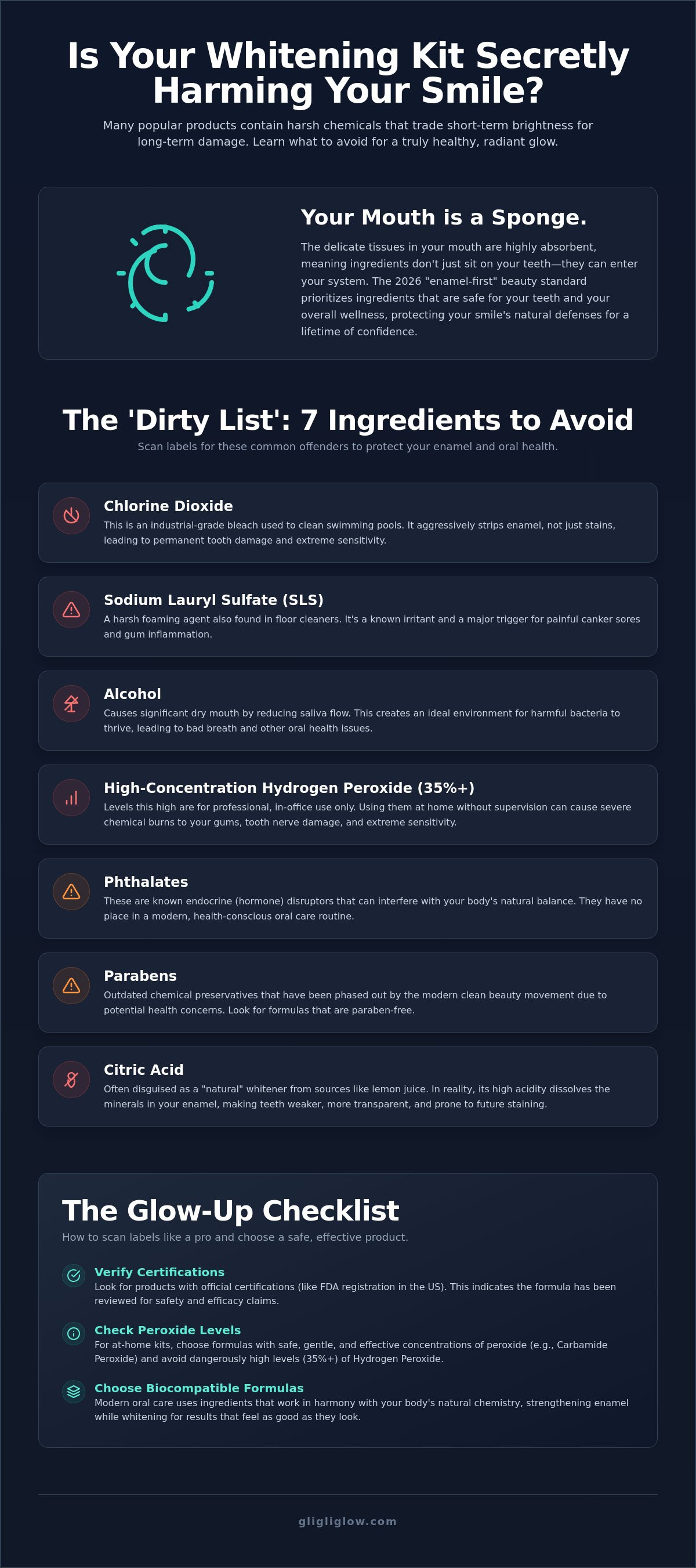
The 'Dirty List': 7 Teeth Whitening Ingredients to Avoid at All Costs
Let's get real about what is actually inside those bargain-bin whitening kits you see on social media. Why do these harsh chemicals even exist in beauty products? Most of the time, it comes down to cost. Brands use cheap, aggressive substances because they produce a fast (but damaging) result. When you're scanning a label for teeth whitening ingredients to avoid, you are essentially looking for chemicals that prioritize a quick fix over your long-term health. 🚫✨
- Chlorine Dioxide: This is literally an industrial bleach used for swimming pools. It doesn't just whiten; it strips.
- Sodium Lauryl Sulfate (SLS): The foaming agent found in floor cleaners. It is a major trigger for painful canker sores.
- Alcohol: It dries out your mouth and creates a desert-like environment where "bad" bacteria thrive.
- High-Concentration Hydrogen Peroxide (35%+): While some peroxide is normal, concentrations this high are meant for professional supervision only. According to research on whitening risks, using these levels at home can lead to severe chemical burns on your gums.
- Phthalates: Known hormone disruptors that can interfere with your body's natural balance.
- Parabens: Outdated preservatives that the 2026 clean beauty movement has firmly left behind.
- Citric Acid: Often disguised as a "natural" brightener, it actually dissolves the very minerals that keep your teeth strong.
Being a conscious consumer in 2026 means knowing that "white" doesn't always mean "healthy." If you want to skip the chemical cocktail and go straight to the glow, choosing a balanced formula like the GLI GLI Teeth Whitening Kit is the smartest move for your self-care ritual. 💖🦷
The Hidden Dangers of Chlorine Dioxide
Chlorine dioxide is the ultimate "enamel stripper." It works by etching the surface of your teeth, which creates an immediate brightening effect. But there is a catch! This etching makes your enamel rough and porous. Think of it like a piece of wood that has been sanded down; it is now much easier for stains from coffee or wine to soak right in. You end up whitening more and more just to stay even, while your teeth become increasingly thin and brittle. Cheap, unbranded kits rely on this because it is incredibly inexpensive to manufacture, but the cost to your smile is way too high. 🛑📉
Preservatives and Foaming Agents: The Silent Irritants
Have you ever experienced that annoying, chronic mouth sensitivity after a whitening session? You can usually blame "stealth" ingredients like SLS and parabens. These don't actually contribute to the whitening power of the product. They are simply there to create a specific texture or to extend the shelf life of the gel. By 2026, the trend is moving toward preservative-free, biocompatible formulas that respect your body. Identifying these teeth whitening ingredients to avoid allows you to enjoy your whitening ritual without the "sensitivity drama" or the fear of hidden toxins. Your routine should be about self-love, not silent irritation! 🌟🧘♀️
DIY Whitening Hacks vs. Dental Damage: The Truth About Kitchen Remedies
We all love a good home-made beauty ritual, don't we? From avocado face masks to honey hair treatments, the "natural is better" movement has taken over our bathrooms. But here is the catch: your teeth aren't like your skin or hair. When you browse social media for a brighter smile, you will find plenty of teeth whitening ingredients to avoid disguised as healthy, "kitchen-safe" alternatives. Just because you can eat an ingredient doesn't mean you should scrub your enamel with it. In fact, some of the most common DIY hacks are the fastest way to permanent dental damage. 🍋🚫
The biggest offender is the "Lemon and Baking Soda" duo. It sounds so innocent, right? In reality, it is a chemical nightmare for your smile. Citric acid from lemons acts as a powerful solvent that dissolves the very minerals that make your teeth white and strong. Once that enamel is gone, it never grows back. By 2026, the "black paste" charcoal trend has also finally faded. We now know that activated charcoal is often far too rough for daily use. It might lift a surface stain, but it usually takes a layer of your tooth's protection with it. 🌑📉
Acidity and the pH Balance of Your Smile
Your mouth is a delicate ecosystem that relies on a specific balance to stay healthy. Scientists talk about a "critical pH" of 5.5. This is the magic number where your enamel starts to literally melt away. When you apply lemon juice or apple cider vinegar to your teeth, you are giving them an acid bath that drops the pH far below that safety zone. The pH scale is a numerical measure from 0 to 14 that indicates how acidic or alkaline a substance is, with lower numbers representing higher acidity that can trigger tooth decay. Following the American Dental Association guidelines is the best way to ensure your DIY curiosity doesn't lead to a dental disaster. Stick to balanced formulas that respect your mouth's natural chemistry! 🧪✨
Abrasivity: The Sandpaper Effect
Have you ever heard of the RDA scale? It stands for Relative Dentin Abrasivity, and it is the standard for measuring how much a product "scratches" your teeth. Many DIY ingredients, like large-grain baking soda or crushed sea salt, have a sky-high RDA. Scrubbing your teeth with these is like using sandpaper on a diamond. It might look brighter for a second because you've removed a stain, but you are also thinning your enamel. As your enamel gets thinner, the yellowish layer underneath, called dentin, starts to show through. This is the ultimate irony: scrubbing too hard actually makes your teeth look more yellow over time! 😱🦷
If you're looking for teeth whitening ingredients to avoid, stay away from anything that feels gritty or tastes like pure vinegar. Your glow-up should be gentle, effective, and totally drama-free. Choose professional-grade alternatives that lift stains without the "sandpaper" side effects. Your future self will thank you for the healthy, sparkling smile! 💖💎
The Glow-Up Checklist: How to Scan Whitening Labels Like a Pro
You've done the hard work of learning which teeth whitening ingredients to avoid, but how do you actually use that knowledge when you're standing in the beauty aisle or scrolling through a website? It's time to channel your inner detective! Think of scanning a label as your ultimate beauty superpower. It's the only way to ensure your ritual is as safe as it is effective. You wouldn't put a random cream on your face without checking the back, and your smile deserves that same level of love. 🕵️♀️✨
Start with the certifications. You want to see FDA or ISO marks prominently displayed. These aren't just boring acronyms. They mean the product was made in a clean, regulated facility that follows strict manufacturing standards. If a brand hides their ingredients or doesn't list a full deck on the packaging, put it back! You have a right to know exactly what is going into your mouth. Transparency is the biggest trend of 2026, and your smile deserves nothing less than total honesty. 📝✅
If you have sensitive teeth, look for "Peroxide-Free" or "Low-Peroxide" labels. While peroxide is a classic choice, some of us need a gentler touch. Check for desensitizing agents like Potassium Nitrate or Sodium Fluoride. These ingredients work by soothing the nerves inside your teeth or reinforcing the enamel surface. Also, pay attention to the shelf life! Old whitening gel can actually become more acidic over time, which increases the risk of irritation. Freshness matters for your glow! 🧊💖
Spotting the Good Stuff
A high-quality whitening gel isn't just about what it lacks. It is also about the nourishing ingredients that keep your mouth feeling fresh and hydrated. Look for Glycerin and Xylitol. These moisture-retaining heroes prevent your teeth from drying out during the process. When it comes to flavor, choose real Menthol or Peppermint oils over synthetic fragrances. They provide that crisp, refreshing sensation without the chemical aftertaste. For more tips on choosing gentle formulas, check out our guide on Natural Whitening Strips: Your Guide to a Peroxide-Free Glow in 2026. 🌿✨
The Red Flag Warning Signs
We've all seen those "too good to be true" ads on social media. If a product arrives in an unlabeled syringe or a plain pen with no ingredient list, that is a massive red flag. Quality ingredients aren't cheap to source, so if the price is rock-bottom, they might be cutting corners with the teeth whitening ingredients to avoid that we discussed earlier. Also, beware of any brand claiming "permanent" results. Teeth are porous and naturally change over time. Permanent whitening is scientifically impossible! Stick to brands that offer realistic, beautiful results. 🛑📉
Ready to skip the guesswork and start your journey with a brand that values transparency? You can grab your GLI GLI Teeth Whitening Kit here and experience professional results without the chemical drama. 💎✨
GLI GLI’s Safety-First Formula: Professional Results, Zero Drama
You’ve learned how to spot the red flags and which chemicals to dodge, but finding a brand that actually walks the talk can feel like a full-time job. That is where we come in! At GLI GLI, we believe your beauty routine should be a source of joy, not a source of "is this safe?" anxiety. We built our entire collection on the "enamel-first" philosophy we discussed earlier. By using dental-grade ingredients that meet the strictest safety standards of 2026, we ensure your glow-up is as healthy as it is dazzling. ✨💖
The secret to our "zero drama" results lies in the synergy between our gentle gel and the GLI GLI LED Whitening Device. Most brands rely on skyrocketing chemical concentrations to get results, but we take a smarter approach. Our LED technology uses specific light wavelengths to accelerate the whitening process. This means we can achieve professional-level brightness without needing the toxic concentrations of peroxide that cause those dreaded shooting pains. It is high-tech beauty that respects your biology! 💎🦷
For those with a packed calendar, the GLI GLI Teeth Whitening Kit fits perfectly into your busy life. It is a 10-minute ritual that feels like a mini-spa break rather than a clinical chore. And when you're traveling or heading to a big event, the GLI GLI Teeth Whitening Pen is your ultimate "on-the-glow" partner. It is perfect for quick touch-ups that keep your sparkle fresh without any fuss. 🌟👜
Our Ingredient Promise
We are obsessed with what goes into our tubes. Our booster gel formula was meticulously crafted to provide maximum lift with minimum irritation. When we talk about teeth whitening ingredients to avoid, we aren't just giving advice; we are setting the standard for our own products. You will never find SLS, parabens, or harsh industrial abrasives in our lineup. We choose biocompatible alternatives that protect your oral microbiome while they work their magic. If you want to dive deeper into how we handle delicate smiles, check out our guide on Sensitive Whitening Strips: The Ultimate Guide to a Pain-Free Glow-Up in 2026. 🌿✨
Join the Glow-Up Movement
Starting your journey to a brighter, safer smile is as easy as unboxing your first GLI GLI Teeth Whitening Kit. We stand by our safety and our sparkle because we know that true confidence comes from knowing you're treating your body with respect. No more "toxic" product fear or confusing labels! We provide the transparency you deserve so you can focus on what really matters: sharing your gorgeous smile with the world. 🌎💖
Ready for your safest glow-up? Shop the GLI GLI collection here. 🛍️✨
Your Brightest, Safest Future Starts Now
You've officially leveled up your oral care game! Now you know that a dazzling smile doesn't have to come at the cost of your health or comfort. By staying away from the teeth whitening ingredients to avoid like harsh industrial bleaches and abrasive DIY hacks, you're choosing to put your enamel first. You've learned how to scan labels like a pro and why biocompatible beauty is the ultimate 2026 trend. 🌟✨
It is time to turn that knowledge into a pampering ritual you actually look forward to. With our dental-grade, FDA-approved ingredients, we've already helped deliver over 50,000+ happy smiles across the globe. Plus, our zero-sensitivity guarantee means you can finally get those professional results without the shooting pains or the drama. You deserve a glow-up that feels as amazing as it looks! 💎💖
Get Your GLI GLI Glow Back Safely — Shop the Kit Now
Go ahead and show off that beautiful, healthy sparkle. The world is waiting for your light! 🌈🙌
Frequently Asked Questions
Is hydrogen peroxide in teeth whitening always bad for you?
Hydrogen peroxide isn't always bad, but the concentration is what matters most for your safety. For unsupervised home use, the American Dental Association suggests keeping hydrogen peroxide levels below 3%. Professional treatments use much higher levels, but these are only safe when a dentist protects your gums first. If you're looking for teeth whitening ingredients to avoid, stay away from high-concentration gels that don't specify the percentage on the label. 🦷✨
Can I use baking soda to whiten my teeth safely at home?
Baking soda is often too abrasive for most people to use safely as a regular whitening method. While it might scrub away a surface stain, its high Relative Dentin Abrasivity (RDA) can literally sand down your protective enamel. Over time, this makes your teeth more sensitive and actually look yellower as the dentin underneath becomes visible. It's much better to use a balanced, dental-grade gel that lifts stains chemically rather than physically. 🛑📉
What is the most dangerous ingredient in cheap whitening kits?
Chlorine dioxide is arguably the most dangerous ingredient found in budget-friendly whitening kits. This chemical is actually an industrial bleach used for disinfecting swimming pools and stripping wood pulp. It works by etching your enamel to create a temporary white look, but it leaves your teeth porous and brittle. This is one of the top teeth whitening ingredients to avoid if you want to keep your smile healthy and strong for years to come. 🚫🏊♂️
Why does my whitening gel make my gums turn white or sting?
Stinging or white spots on your gums are clear signs of a chemical burn from an aggressive product. This happens when high-concentration bleaching agents or harsh foaming agents like Sodium Lauryl Sulfate (SLS) come into contact with your soft tissues. It is a signal that the gel is too harsh or that the application tray doesn't fit your mouth properly. If this happens, stop the treatment immediately and let your gums heal with some soothing salt water rinses. 🧊💖
Are there any teeth whitening ingredients that are safe for breastfeeding moms?
Most dental professionals advise waiting until you've finished breastfeeding before starting a chemical whitening routine. There isn't enough documented research to prove that peroxide-based bleaches are 100% safe for nursing infants. If you want a brighter smile now, focus on professional cleanings and non-toxic, peroxide-free options that use biocompatible ingredients. Always check with your doctor or lactation consultant before trying any new health ritual during this special time. 🤱✨
How can I tell if a whitening product is FDA-approved?
You can verify a product's status by looking for an FDA registration number or a "Made in an FDA-registered facility" claim on the box. Legitimate brands are proud of their safety standards and will make this information easy to find. If the packaging is missing a full ingredient list or manufacturer details, it's a major red flag. You can also search the FDA's online database for specific manufacturer names to ensure they meet modern 2026 regulations. 📝✅
Does charcoal toothpaste actually work, or is it too abrasive?
Charcoal toothpaste can lift surface stains, but it is generally considered too abrasive for long-term daily use. The gritty texture that makes it "work" can also wear down your enamel shield over time. By 2026, many experts suggest skipping charcoal in favor of LED-boosted gels. These give you a much deeper glow without the "sandpaper effect" that charcoal often has on your delicate tooth structure. Keep your routine gentle and your enamel happy! 🌑💎
What should I do if I accidentally used a product with chlorine dioxide?
If you've used a product containing chlorine dioxide, stop using it right away! Rinse your mouth thoroughly with plain water to remove any remaining residue. It's a good idea to schedule a visit with your dentist so they can check for any enamel etching or surface roughness. They can often apply a professional fluoride treatment to help remineralize and strengthen the areas that were weakened by the harsh chemicals. Your smile can bounce back with the right care! 🌈🙌


