


What if that "natural" black paste you’re scrubbing onto your teeth is actually making them look yellower in the long run? We all want a dazzling, confident smile without the scary dental bills; it’s so tempting to grab a cheap jar of powder when it looks like a magic eraser for stains. But the big question remains: does charcoal teeth whitening actually work, or are we just falling for a messy trend?
We totally get it. You want to treat your morning routine as a pampering ritual and an act of self-love, not a science experiment that causes damage! 🌿 This article promises to reveal the truth about why activated charcoal is often too abrasive for daily use. We’ll look at why the ADA still hasn’t granted its seal of approval and how these "natural" scrubs can leave your teeth vulnerable to sensitivity.
Get ready to discover the science behind your smile and why your enamel is worth protecting at all costs. We are previewing the risks of permanent abrasion and sharing the most effective, tech-forward ways to get a professional glow-up in 2026. Let’s find your brightest, most confident look together! ✨
Key Takeaways
- Understand that activated charcoal works through physical abrasion, meaning it "scrubs" away surface stains rather than actually whitening your teeth from within. ✨
- Get the final verdict: does charcoal teeth whitening actually work for deep stains? (Spoiler: it only handles the surface and can't change your intrinsic tooth color!)
- Learn why protecting your enamel is non-negotiable, as charcoal's high abrasivity can cause permanent damage that actually makes teeth look more yellow over time. 🦷
- Compare the messy "Scrub Method" of the past with the modern, safe "Glow Method" using LED technology and professional-grade gels for 2026.
- Discover how to achieve a dazzling, expert-level smile at home using gentle, dental-formulated kits that prioritize your long-term oral health and confidence. 💖
What is activated charcoal and why is it all over your feed?
If you’ve scrolled through your feed lately, you’ve definitely seen it. That striking, slightly scary image of someone with a pitch-black smile, looking like they’ve just bitten into a piece of coal. It’s the ultimate "trust the process" moment! But beyond the visual shock factor, you’re probably sitting there with your toothbrush in hand wondering: does charcoal teeth whitening actually work, or is it just a messy gimmick that’s going to ruin your sink? 🧼
To understand the hype, we first need to look at What is activated charcoal exactly. It isn't the stuff you use for a summer barbecue! It’s a fine black powder made from natural materials like coconut shells or wood that have been heated to extreme temperatures. This process "activates" the carbon, creating millions of tiny, microscopic pores that are ready to trap everything in their path. While it’s a hero in the medical world, using it on your teeth is a totally different story.
The science of 'activation'
Think of activated charcoal as a tiny, super-powered sponge. During the high-heat activation process, the oxygen is stripped away, leaving behind a porous structure that loves to grab onto particles. In a medical setting, like an ER, doctors use it because it’s incredible at binding to toxins. However, there’s a big "toxin-binding" myth when it comes to your smile. While charcoal is great at absorbing chemicals in your stomach, it doesn't "draw out" stains from deep inside your teeth. Instead, those tiny, gritty pores act more like sandpaper on your surface enamel. It’s a physical process, not a chemical one, and that’s a distinction your teeth really care about! 🦷
Why it became a beauty sensation
Why did we all suddenly start brushing with black soot? It’s all about that viral aesthetic! Seeing a "dirty" black paste turn into a bright white smile makes for incredible video content, and we've all been mesmerized by those "before and after" clips. In 2026, the shift toward ingredient-conscious beauty has made charcoal seem like a "back-to-basics" miracle. Influencers love the "raw" and "natural" vibe, often bypassing traditional dental advice to promote these "earthy" alternatives. But we have to remember that "natural" doesn't always mean "dental-safe." Just because an ingredient comes from a coconut shell doesn't mean it’s meant for your delicate smile every single day. We’re here to help you find that perfect balance between a trendy glow and long-term health! ✨
So, does charcoal teeth whitening actually work for the long haul, or are you just scrubbing away your tooth's best defense? Let’s dive deeper into what’s happening beneath that black foam.
Does charcoal teeth whitening actually work for deep stains?
Let’s get real about those results. When you see that bright flash in the mirror after rinsing, it’s easy to think you’ve found the holy grail. But does charcoal teeth whitening actually work for the deep, yellow tones we really want to fix? The short answer is: not really. Charcoal is a physical abrasive, not a chemical whitener. It "sandpapers" off coffee and tea residue but doesn't change the tooth's base color. This means you’re essentially just cleaning the surface, not changing the actual shade of your smile. ☕️
There is also a sneaky "Optical Illusion" at play here. When you cover your teeth in dark, jet-black paste, your eyes adjust to that intense contrast. Once you rinse it away, any hint of natural tooth color looks dazzlingly white by comparison. It’s a clever visual trick that makes you feel like you’ve made massive progress, even if your enamel remains the same shade underneath. If you’re looking for a real change that lasts, you might want to explore professional whitening alternatives that go beyond surface-level scrubbing.
Physical vs. Chemical whitening
To understand the limits, we have to look at how whitening actually happens. Physical whitening is like using a gritty face scrub. It removes the "extrinsic" stains, which are the daily leftovers from your favorite red wine or morning espresso. Chemical whitening is different. It uses oxygen molecules to enter the enamel and break up "intrinsic" stains, the deep pigments that live inside the tooth. Physical scrubbing has a very low "ceiling" for how white you can go. Once you've removed the surface film, you're done. You can't scrub your way to a Hollywood glow without actually changing the tooth's chemistry. ✨
The limit of absorption
The marketing often claims that charcoal "pulls" toxins out of your teeth. In reality, charcoal particles are far too large to enter the microscopic pores of your enamel. Even if they could, the hidden risks of charcoal toothpaste suggest that the friction causes more harm than good. Charcoal needs significant time to bind to substances; a quick two-minute brush just isn't long enough for that "magnetic" effect to happen. So, does charcoal teeth whitening actually work for deep-set pigments? Most of what you see in the sink is just the removal of last week's latte stains, not a permanent transformation. Real whitening requires a controlled process that respects your enamel's health. 🦷
The hidden risks: Is charcoal hurting your enamel?
It’s time for a little heart-to-heart about your enamel. We all want that instant glow, but your teeth’s protective layer is precious. It’s a one-time gift from nature! ✨ Once you scrub it away, it’s gone for good. When asking does charcoal teeth whitening actually work, we have to look at the long-term cost of that temporary brightness. Most charcoal products sit dangerously high on the Relative Dentin Abrasivity (RDA) scale. While your standard toothpaste is designed to be gentle, many charcoal powders act like a heavy-duty exfoliator for your smile. According to a systematic review of studies, these products often lack the safety evidence we need to recommend them for daily use.
Here is the secret nobody tells you: the "Yellowing Trap." As you use these abrasive scrubs, you’re slowly thinning your enamel. Since your enamel is white and the dentin underneath is naturally yellow, your teeth can actually start to look darker and more aged the more you "whiten" them. It’s the exact opposite of the fresh, youthful look we’re going for! Plus, many of these "raw" charcoal pastes skip out on fluoride. Without that essential mineral, you’re leaving your thinned enamel even more vulnerable to cavities and decay. It's just not worth the risk to your beautiful smile. 🦷
Increased tooth sensitivity
Ever felt that sharp, icy "zinger" when you take a sip of cold water? That’s your teeth telling you they’ve had enough. When charcoal wears down your enamel, it exposes the sensitive nerves hiding in your dentin. It’s not a fun vibe! If you’re already feeling the pinch, it’s much better to switch to sensitive whitening strips that focus on a pain-free glow-up. You deserve a routine that feels like a kényeztető rituálé, not a painful chore. ✨
Gum irritation and recession
Your gums are just as delicate as your favorite silk dress. Brushing with gritty charcoal can cause micro-tears in the tissue, leading to inflammation and even permanent recession. Dentists are seeing more cases where those tiny black particles get stuck under the gum line, causing long-term irritation. Protecting your smile means loving your gums just as much as your teeth. Let’s choose rituals that nourish your beauty rather than stripping it away. You’ve got this! 💖
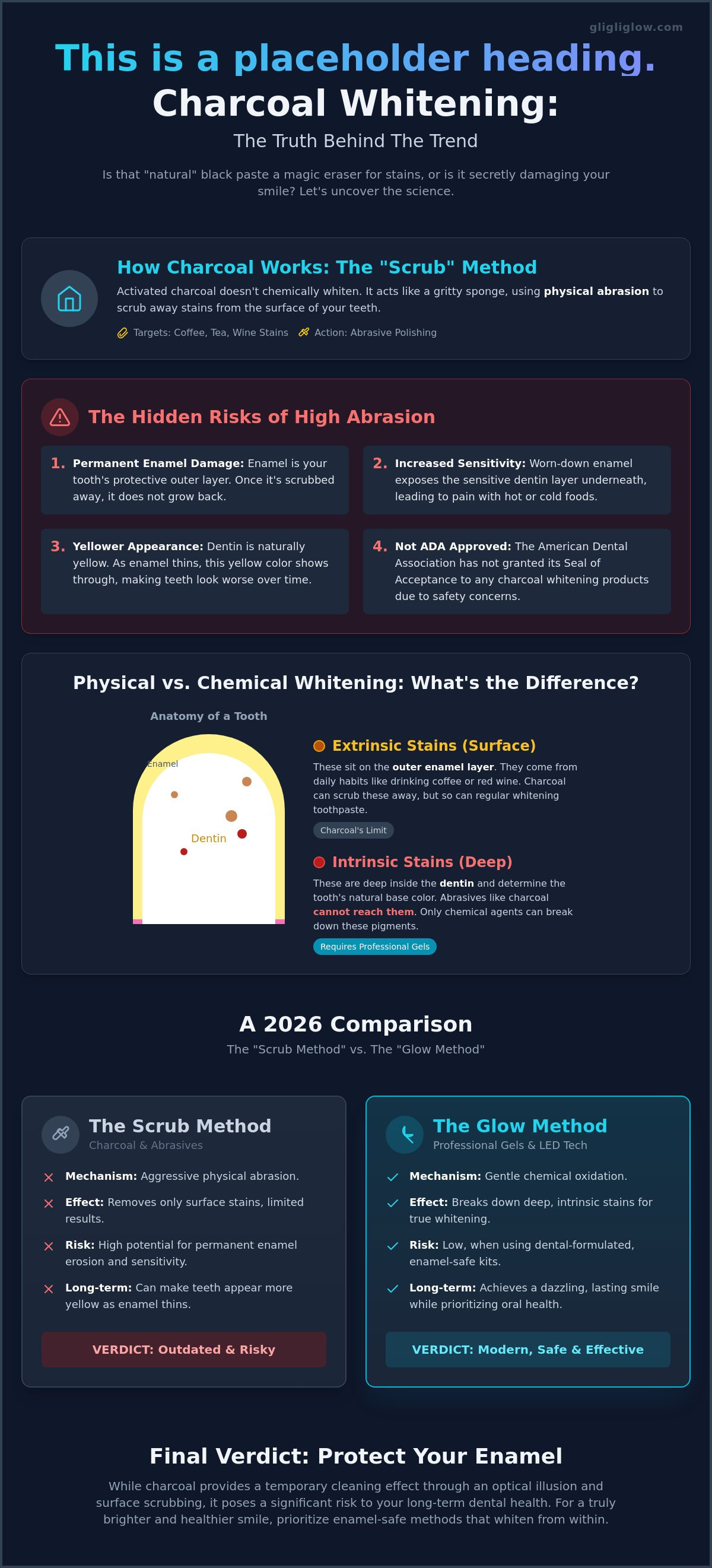
Charcoal vs. Professional Gel: A 2026 comparison
We’ve looked at the grit, so let's look at the glow! Choosing between charcoal and professional gel is like deciding between scrubbing your floors with steel wool or using a high-tech steam cleaner. Both might look like they're cleaning, but the long-term impact is worlds apart. When people ask does charcoal teeth whitening actually work, they often forget to compare it to the gold standard of modern care. The reality is that charcoal is a temporary fix with a high risk of damage, while dental-grade gels offer a safe, lasting transformation. 🌟
The biggest difference lies in how these methods interact with your smile. Charcoal relies on uncontrolled abrasion. It’s essentially a guessing game of how much surface you’re rubbing away to find the white underneath. Professional gels use controlled oxidation. This smart process uses oxygen molecules to gently lift pigments without the sandpaper effect. Plus, professional formulas prioritize pH balance. Keeping your mouth’s environment stable prevents the irritation and "zingers" often associated with raw, unpredictable materials like charcoal. Why settle for a risky scrub when you can have a sophisticated ritual? ✨
Why LED and Gel are the gold standard
In 2026, blue light technology is the ultimate game-changer for your beauty routine. This cool-toned LED light accelerates the whitening gel without using heat, ensuring your comfort while speeding up the results. It helps dental-grade ingredients penetrate deeper to lift those stubborn, years-old stains that charcoal simply can't touch. If you want to see how this tech stacks up against the competition, check out our guide on the best at-home teeth whitening kit 2026 for a full breakdown. It’s all about getting that expert-level shine from the comfort of your own vanity! 💖
The mess factor and convenience
Let’s be honest: charcoal is a nightmare for your bathroom aesthetic. Black stains on your white towels, dark speckles in your grout, and a sink that looks like a coal mine after every brush? No thanks! Professional kits offer a precise, hands-free experience that fits perfectly into your busy life. There’s no cleanup and no stress. Beyond the mess, think about the long-term cost. Saving a few dollars on a jar of charcoal now could lead to massive dental bills for enamel repair later; for those needing advanced restorative solutions, Implantološki centar Smile provides the professional expertise required to rebuild a healthy smile. Investing in a safe, proven method is an act of self-love for your future self. 🦷
Ready to ditch the mess and embrace a professional glow? Grab your GLI GLI LED Whitening Device today and start your journey to a safer, brighter smile!
Achieve your brightest glow safely with GLI GLI
Choosing the right path for your smile shouldn't feel like a gamble. At GLI GLI, we believe that your beauty routine should be a moment of pure joy and self-care, not a risky experiment. While we’ve explored the question does charcoal teeth whitening actually work, it’s clear that the "scrub" method isn't the vibe for anyone who values their long-term oral health. Our philosophy is simple: we deliver that dazzling, professional-level glow without compromising your precious enamel. Our kits are dental-expert formulated to ensure you get the results you crave while keeping your teeth strong and happy. ✨
Our GLI GLI LED Whitening Device is a total game-changer for the modern, busy individual. No more messy sinks or black grout! Instead, you get a sleek, high-tech experience that fits perfectly into your morning or evening ritual. We stand by our results with the GLI GLI guarantee; you get that professional radiance from the comfort of your own home, on your own terms. It’s about more than just white teeth; it’s about that inner confidence and self-love that shines through every time you smile. 💖
Safe ingredients for a happy smile
We take your smile seriously, which is why we only use FDA-approved, non-abrasive whitening agents. Unlike the gritty, unpredictable texture of charcoal, our gels are smooth, gentle, and specifically designed to protect sensitive teeth. You can achieve up to 8+ shades of lift without those scary "zingers" or the enamel thinning we mentioned earlier! 🦷 To keep that glow-up looking fresh, our specialized booster gels are the perfect addition to your maintenance routine. They ensure your smile stays vibrant and healthy for months, not just days.
Your new 15-minute ritual
Ready to upgrade your self-care? Integrating GLI GLI into your day is so easy, it’s practically a meditation. It’s a whole vibe! 🌿
- Prep: Give your teeth a quick brush and dry them off so the gel can work its magic.
- Glow: Apply the gel with our precision pen and pop in the LED device for just 15 minutes.
- Shine: Rinse and reveal your new, radiant smile.
Time to Choose Your Ultimate Glow
Your smile is your most powerful accessory, and it deserves a ritual that nourishes rather than strips. We've seen that while the charcoal trend is captivating on social media, the answer to does charcoal teeth whitening actually work for a true, deep transformation is a resounding no. Real, lasting results come from smart science and gentle oxidation, not from sanding down your precious enamel. Protecting your natural beauty today is the best gift you can give your future self. ✨
You're ready for a routine that feels like a kényeztető rituálé and delivers expert-level shine. Our dental-expert developed formulas use only FDA and ISO-approved ingredients, ensuring your safety is always the priority. Plus, we're so confident in your new look that we offer a 100% result guarantee! It's time to ditch the messy black powder and embrace the tech-forward way to shine. Ready for a real glow? Shop the GLI GLI Teeth Whitening Kit now! Let's get you that confident, dazzling smile you've been dreaming of! 💖
Frequently Asked Questions
Is charcoal teeth whitening safe to use every day?
No, you definitely shouldn't use charcoal every day because it's simply too abrasive for your enamel. While it's tempting to brush with it daily for that "clean" feeling, it acts like sandpaper on your teeth. Most dental professionals recommend limiting abrasive scrubs to once a week at most to avoid permanent damage. ✨
Can charcoal whitening damage my dental work like crowns or veneers?
Yes, charcoal can absolutely scratch and dull your expensive dental work. Since crowns and veneers are made of porcelain or composite resin, they don't have the same "self-healing" properties as natural teeth. Those gritty black particles can also get trapped in the tiny crevices around your restorations, leaving a dark, permanent stain that's hard to remove. 🦷
How long does it take to see results from charcoal toothpaste?
You might notice surface stains disappearing within a few days, but don't expect a Hollywood transformation. When people ask does charcoal teeth whitening actually work, they often see a quick removal of coffee or tea film. However, since it doesn't penetrate the tooth to change the actual shade, your results will hit a "ceiling" very quickly. ☕️
Why do my teeth look yellower after using charcoal for a few weeks?
Your teeth look yellower because your white enamel is getting thinner, which reveals the naturally yellow dentin underneath. This "rebound effect" is a major red flag for charcoal users. Instead of getting whiter, your smile loses its protective shield and starts to show the darker internal layers of the tooth. It's the opposite of the glow-up we want! 🌟
What is the best natural alternative to charcoal for whitening?
The best alternative is a professional-grade kit that uses safe oxidation instead of physical scrubbing. You want a system that lifts stains from the inside out without scratching your surface. Using a LED device with a gentle, dental-expert formulated gel provides a much safer, more effective glow that protects your enamel for years to come. 💖
Does charcoal help with bad breath while whitening?
Charcoal can temporarily absorb odors in your mouth, but it isn't a cure for bad breath. While it might give you a fresh feeling for an hour, it doesn't kill the bacteria that cause halitosis. It's much better to stick to a balanced oral routine with fluoride and tongue scraping for long-term freshness that actually lasts. 🌿 To support your body's natural bacterial balance for overall wellness, you can find out more about the specialized probiotics offered by Love Biotica.
Can I use charcoal if I have sensitive teeth?
You should definitely avoid charcoal if you struggle with sensitivity. Because charcoal is so abrasive, it can quickly expose the nerves in your teeth, leading to those painful "zingers" when you drink cold water. If your teeth are already delicate, stick to non-abrasive gels and soothing treatments that prioritize your comfort and confidence. ✨


