


What if the best dental-office retail programme feels less like selling and more like thoughtful aftercare? That’s the idea behind selling retail products in a dental office: offer a few useful options that complement patient needs, with clear guidance and no pressure to buy.
It’s natural to worry that product recommendations could feel pushy or distract from care. With limited staff time, display space, and insight into what sells, adding retail can seem like one more thing to manage. A patient-first approach keeps the focus where it belongs: helping people feel confident about their at-home routine while protecting the trust they place in your team.
This 2026 guide explains how to choose a focused product range, build a simple recommendation and checkout process, and review practical measures alongside patient feedback. It also covers how at-home whitening products can fit as one retail category for patients interested in whitening between visits. With a thoughtful plan, retail can support aftercare without feeling like a detour from the patient experience.
Key Takeaways
- Build your retail range around products that address real patient interests, and start small to keep choices clear and stock manageable.
- When selling retail products in a dental office, put education first and make every purchase optional to support patient trust.
- Use a simple conversation flow: ask about the patient’s needs, explain a relevant option, invite questions, and leave the decision to them.
- Make the workflow easy to maintain by assigning responsibility for stock checks, expiry monitoring where applicable, checkout, and replenishment.
- Launch with a clear checklist, compare wholesale partners for product fit and ordering ease, then review the programme using practical measures and patient feedback.
Why sell retail products in a dental office? Start with patient needs
Dental-office retail means making relevant products available alongside care, not making a purchase part of treatment. A patient might appreciate an at-home oral-care option after asking how to maintain a routine between visits. That convenience can connect the office conversation with everyday habits, but it doesn’t guarantee a clinical result or improve practice finances by itself.
Trust comes first. Dentistry is a healthcare profession, as outlined in this high-level overview of Dentistry, so recommendations should be transparent, optional, and grounded in what the patient has shared. Keep product education separate from clinical advice: staff can explain a product’s stated use and instructions, while questions about symptoms, suitability, or treatment belong with the treating dental professional.
What does patient-first retail look like in a dental practice?
Start with a patient’s stated needs, questions, or aftercare conversation, not a sales target. Explain why an option may be relevant, where to find its product information, and that buying it is entirely up to the patient. Their decision must not affect their care.
Helpful: “You mentioned wanting to explore at-home whitening. I can show you an option and its instructions, or you can take a look later.” Pressure-based: “You should buy this today.” The first gives the patient a choice; the second applies pressure.
Which products can complement a dental office?
Think in categories, then match them to the questions patients actually raise. Everyday oral-care items, such as toothbrushes or flossing aids, may suit conversations about home routines. At-home whitening products may be relevant to patients who ask about whitening. Keep these distinct from in-clinic procedures: a retail product is for at-home use and isn’t a substitute for an in-office service or individual clinical guidance.
For at-home whitening category context, explore this at-home teeth whitening kit guide. A focused selection is easier to explain than a crowded shelf of overlapping options. Choose products your team can describe clearly, and share accurate product information. If a patient asks whether a product is right for them, refer the question to their dental professional. That keeps the recommendation useful and patient-focused.
How to choose retail products for a dental office
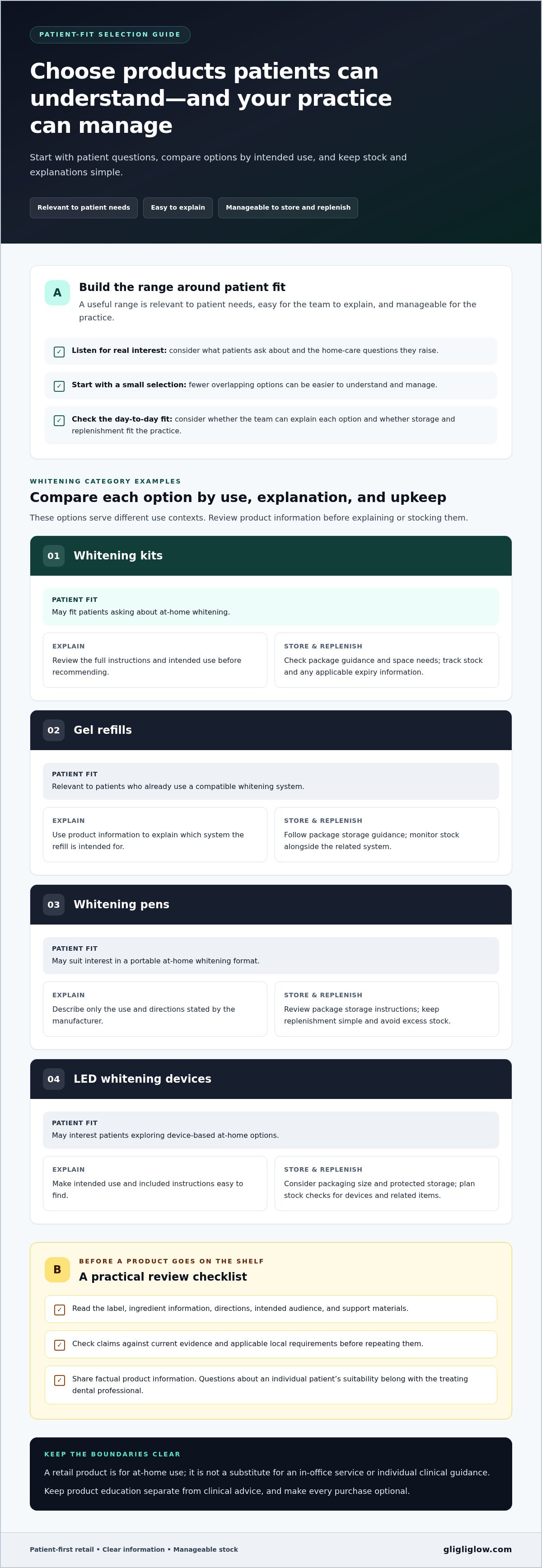
A useful product range starts with patient fit, not a supplier’s catalogue. Consider what patients ask about, whether your team can explain each option, and whether the products suit your storage and replenishment routine. Begin with a small selection. Too many overlapping choices can make recommendations harder to understand and stock harder to manage.
A patient-fit product range is relevant to patient needs, easy to explain, and manageable for the practice. Use the criteria below to compare categories before deciding what belongs on your shelf.
| Category | Patient relevance | Ease of explanation | Storage needs | Replenishment |
|---|---|---|---|---|
| Whitening kits | May fit patients asking about at-home whitening. | Review the full instructions and intended use before recommending. | Check package guidance and space needs. | Track stock and any applicable expiry information. |
| Gel refills | Relevant to patients who already use a compatible whitening system. | Explain which system the refill is intended for, using product information. | Follow the package’s storage guidance. | Monitor stock alongside the related system. |
| Whitening pens | May suit interest in a portable at-home whitening format. | Describe only the use and directions stated by the manufacturer. | Review package storage instructions. | Keep replenishment simple and avoid excess stock. |
| LED whitening devices | May interest patients exploring device-based at-home options. | Make intended use and included instructions easy to find. | Consider packaging size and protected storage. | Plan stock checks for devices and related items. |
How should a practice compare product categories?
These categories serve different use contexts, so don’t present a refill as a standalone system or a device as a clinical procedure. Before adding an option, check whether patients can understand its intended use from the product information. If sensitivity comes up in a whitening conversation, this guide to sensitive whitening strips offers category context, not an individual recommendation.
What should staff review before adding a product?
Read the label, ingredient information, directions, intended audience, and any support materials. Check claims against current evidence and applicable local requirements before repeating them in the practice. Resources on dental marketing compliance can help frame a broader review; requirements may vary by location.
Set a clear boundary for staff: they can share factual product information, but a recommendation about an individual patient’s suitability is a clinical question for the treating dental professional. For a focused example of an at-home whitening category, explore GLI GLI’s at-home whitening products.
How to sell retail products without undermining patient trust
Trust depends on how a recommendation is made, not just on the product. Put education first, make purchasing optional, and keep clinical care independent of any sale. A patient’s decision to buy, wait, or decline shouldn’t change the care they receive. This patient-first balance aligns with the ethical guidelines for dental practices, which address the relationship between professional responsibilities and business activity.
Use a simple sequence: ask, explain, invite questions, then leave the decision to the patient. Staff can share factual information about a product’s stated intended use and where to find its instructions. They shouldn’t promise a treatment outcome or suggest that a retail item will resolve a clinical concern. If a patient asks whether a product is suitable for their situation, refer the question to the appropriate dental professional.
What can staff say when introducing a product?
Keep the language plain and neutral. For example: “You mentioned you’re interested in at-home whitening. I can show you an option and point out where its directions are, if that would be helpful.” This explains why the product came up without implying a result or pressing for a purchase.
If the patient declines, respond warmly: “Of course. Let me know if you have questions later.” Avoid urgency, repeated offers, or awkward follow-up. A calm response reinforces that the recommendation was an option, not an expectation.
How can a practice keep recommendations consistent?
Create a brief staff guide so patients hear clear, accurate information from everyone. Keep it practical and easy to update. Include:
- Approved product facts: intended use, directions, and where patients can find the full instructions.
- Referral boundaries: which questions are factual and which require a dental professional’s clinical judgment.
- Common questions: concise answers based on product information, plus a clear route for questions the guide doesn’t cover.
Train the team not to turn product details into personalised clinical recommendations. Staff may describe what the label says, but a patient-specific question about suitability belongs with the treating professional. That distinction matters especially for products connected to treatment concerns or expected outcomes.
Before using a script, sign, or other promotional material, check that claims are clear, accurate, and supported. Professional, advertising, and consumer requirements can vary by jurisdiction, so review materials against applicable local guidance. Revisit the guide when product information or practice procedures change. A consistent approach makes selling retail products in a dental office easier to explain while keeping patient choice at the centre.
How to set up retail displays, stock, and a simple sales workflow
A smooth retail setup should fit the patient journey, not compete with it. Walk through the office as a patient would, from arrival and check-in to the end of the visit. Choose a spot where patients can notice product information without blocking the reception desk, crowding the waiting area, or mistaking retail materials for clinical instructions.
How can a dental office merchandise products clearly?
Keep the display tidy and selective. Use a short description of each product’s intended use, then direct patients to the full instructions and any applicable notices. Make sure promotional copy doesn’t overstate product claims. A small, readable display near a natural pause in the patient journey is more useful than a crowded shelf competing for attention at check-in.
Pair each product with a straightforward next step: invite a question, offer an information sheet, or explain where to find the instructions. Keep clinical guidance separate from retail signage so patients can tell which information comes from the product and which comes from their care team.
Which measures help evaluate a retail pilot?
Start with a small pilot and choose a review period before launch. Assign an owner for stock checks, expiry monitoring where applicable, checkout, and replenishment. Use a simple tally or an existing practice system to record enquiries, purchases, and stock movement. Keep records limited to what the practice needs, follow its privacy practices, and avoid adding unnecessary patient details to retail tracking.
At review time, look beyond sales. Ask staff how much time the process takes, which questions come up repeatedly, whether products move as expected, and whether replenishment is manageable. Invite patient feedback without pressure. Sales figures can help assess operations, but they don’t measure care quality or prove a product is right for every patient.
Have one person gather these observations and share them with the team. Then decide whether to keep the range as it is, adjust the display, refine product information, or change stock levels. This creates a practical feedback loop for selling retail products in a dental office without letting retail activity disrupt care.
For a focused at-home whitening category, explore GLI GLI wholesale teeth-whitening products as one option for your retail range.
How to launch a dental-office retail programme and choose a wholesale partner
A strong launch doesn’t need to be complicated. Keep the first version focused, give the team clear product information, and set a date to review how the programme is working. This makes selling retail products in a dental office easier to manage and gives you a chance to refine the approach using patient and staff feedback.
Use this launch checklist to get started:
- Select one product category that fits the questions and interests you hear from patients.
- Document product facts, including intended use, instructions, ingredient information, and approved wording for claims.
- Train staff on how to explain the product, answer basic questions, and route clinical suitability questions to the appropriate dental professional.
- Set a review date before launch and decide what you’ll assess, such as enquiries, stock movement, staff effort, and patient comments.
What should a dental practice look for in a wholesale partner?
Compare potential partners on more than product selection. Consider whether the range suits your patients, whether educational materials help staff explain products accurately, and whether ordering and replenishment fit your storage and administrative capacity. Clear product documentation matters, too. Review supplier claims and materials against relevant local professional and consumer requirements before sharing them with patients.
GLI GLI offers wholesale opportunities to dental professionals and retailers globally, with at-home teeth-whitening and oral-care products including kits, gel refills, pens, and LED whitening devices. This range can fit a practice whose patients ask about at-home whitening. Keep the product’s intended use clear, and don’t present at-home products as in-clinic procedures.
How can a practice improve its retail programme over time?
Bring several signals together at each review: patient feedback, staff experience, product questions, stock movement, and the effort required to manage inventory and checkout. Sales alone won’t show whether the programme is useful or comfortable for patients. Look for practical patterns. Are people asking the same unanswered question? Is an item difficult to explain? Does replenishment take more time than the team can reasonably spare?
Keep products that suit patient needs and are straightforward to explain. Simplify or remove options that cause confusion or create extra work without clear value. Refresh staff guidance whenever product information, instructions, or applicable requirements change. To explore at-home whitening as a retail category, take a look at GLI GLI’s products and wholesale opportunities.
Build a retail programme patients can feel good about
Successful retail starts with a simple principle: recommend products because they connect to patient interests, not because a sale is the goal. Choose a focused range your team can explain clearly, keep purchases optional, and direct clinical questions to the treating dental professional.
Then make the programme easy to run. Give staff clear roles for product information, stock, and checkout, and review patient feedback alongside stock movement and the effort involved. These practical steps help selling retail products in a dental office stay thoughtful, transparent, and manageable for your team.
At-home whitening may be one category to explore. GLI GLI offers global wholesale opportunities for dental professionals and retailers, with at-home whitening kits, gel refills, pens, and LED devices. Explore GLI GLI wholesale products for your practice and see whether the range fits your patient-first approach.
Start small, listen closely, and let patient needs guide what comes next. A well-chosen product can be a helpful addition to an everyday care routine without taking centre stage over care itself.
Frequently Asked Questions
Is it appropriate for a dental office to sell retail products?
Yes, retail can be appropriate when products support patient interests and remain separate from clinical care. Keep purchases optional, explain why an item may be relevant, and make sure declining doesn’t affect treatment or the patient’s relationship with the practice. Requirements for dental practices and product sales can vary by location, so review applicable professional, consumer, advertising, and tax rules before launching a programme.
What retail products can a dental office sell?
A practice can consider oral-care products that suit its patients and that staff can explain accurately, such as brushing or flossing aids and at-home whitening products. Whitening options include kits, gel refills, pens, and LED devices, each with its own intended use and instructions. Choose a focused range rather than stocking every category. Retail products for home use are distinct from in-clinic procedures.
How can a dentist recommend products without sounding pushy?
Start by asking about the patient’s needs or interests, then offer relevant product information in plain language. Invite questions and leave the decision with the patient. For example: “You mentioned wanting to learn about at-home whitening. I can show you an option and where to find its instructions, if you’d like.” If they decline, accept that warmly. Avoid urgency, pressure, or promises about results.
Can dental practices sell teeth-whitening products for home use?
Practices may consider offering at-home whitening products as retail items, while checking the professional, consumer, and product requirements that apply in their location. Make the intended use and manufacturer’s instructions clear, and don’t present a home-use product as an in-clinic procedure. Questions about whether whitening is suitable for an individual patient, or concerns about symptoms, should go to the treating dental professional.
How should a dental office choose products to stock?
Choose products based on patient interest, clear instructions, ease of explanation, storage needs, and how simply they can be replenished. Review labels, ingredient information, intended use, and product claims before adding items. A narrow selection is often easier for staff to explain and manage than several overlapping options. Start with a small range, then use patient questions and team feedback to guide adjustments.
How can a dental office track retail product sales?
Use a straightforward tally or an existing practice system to record enquiries, purchases, stock movement, and replenishment needs. Set a review period and assign someone to collect the information. Keep tracking consistent with the practice’s privacy practices, and avoid recording patient details that aren’t needed. Review staff workload and patient feedback alongside sales, since revenue alone doesn’t show whether the programme is useful or well received.
Do dental-office retail products replace professional dental advice?
No. Retail products can support an at-home routine, but they don’t replace an examination, diagnosis, treatment plan, or advice from a dental professional. Staff can explain factual product information, including its stated intended use and instructions. For questions about symptoms, treatment outcomes, or whether a product is suitable for a particular patient, direct the conversation to the treating dental professional.


