


What if the first step toward a brighter smile isn’t choosing a whitening product, but checking your gum health? If you’re considering teeth whitening for people with receding gums, it’s understandable to have questions about sensitivity and uneven results. Exposed roots don’t have the same enamel covering as the rest of the tooth, so they may feel more sensitive and respond differently to whitening.
You don’t have to guess your way through the options. This guide explains how gum recession can affect whitening, when to pause and seek a dental assessment, and what to compare before choosing an approach. It also explains why a product labelled “sensitive” or “gentle” isn’t guaranteed to feel comfortable for everyone.
We’ll compare at-home approaches with dental guidance and look at sensitivity-focused options, including the GLI GLI Teeth Whitening Kit. Your oral health should guide the decision. If your gums are inflamed or you’re already experiencing discomfort, understand what may need attention before pursuing a whiter shade. ✨
Key Takeaways
- Gum recession affects the whitening decision. Distinguish a receded gumline from tooth stains before choosing an approach.
- With teeth whitening for people with receding gums, exposed roots may respond differently from enamel and affect how even the result looks.
- Pause whitening and seek a dental assessment if you have inflamed gums, ongoing discomfort, or other oral-health concerns.
- Compare at-home options with dental guidance for supervision and personalisation. A “sensitive” label doesn’t guarantee a product is suitable for every gumline.
- Follow product directions exactly and pay attention to how your teeth and gums feel. Consider the GLI GLI Teeth Whitening Kit with your individual suitability in mind.
Can you whiten teeth with receding gums? Start with what recession means
Yes, whitening may be possible for some people with receding gums, but the right next step depends on what’s happening in your mouth. Gum recession means the gumline has moved back, exposing more of a tooth than before. That’s different from discolouration, which changes how a tooth looks but doesn’t mean the gums have shifted.
The visible part of a tooth is usually its crown, which is covered by enamel. Below the gumline, the root surface isn’t covered by enamel in the same way. As described in this overview of gingival recession, recession can expose root surfaces that gum tissue once protected. How noticeable the recession is, whether you have sensitivity or other symptoms, and your dental history can all affect what makes sense next.
What happens to teeth when gums recede?
When the gumline pulls back, more of the root surface may be exposed. Some people notice sensitivity to cold drinks, heat, sweet foods, or brushing; others have recession without pain. Symptoms alone don’t show the cause or extent of recession. An individual dental assessment is needed to evaluate what’s happening and whether anything needs attention.
If your gums are sore, inflamed, bleeding, or changing, pause before whitening and seek dental advice. These signs deserve attention before you add a whitening product to your routine.
Why does recession matter before whitening?
Whitening products aim to change the shade of natural teeth. They don’t move the gumline back or treat the reason it has receded. Exposed roots may react differently from enamel: whitening ingredients can trigger sensitivity or irritation, and root surfaces may not lighten to the same degree as enamel. The final colour can look uneven as a result.
Results can also vary between natural teeth and dental restorations, such as crowns or fillings. Don’t assume every visible surface will change in the same way, or that whitening will address a darker area near the gumline.
For teeth whitening for people with receding gums, the useful first question isn’t simply “Which product whitens best?” It’s “Is my mouth ready for whitening, and which areas might respond differently?” A dental professional can consider recession, symptoms, and dental history together to help you make an informed choice before you begin.
How whitening may affect exposed roots, enamel, and sensitivity
Whitening can change the appearance of some stains, but it doesn’t work like a surface polish alone. Some whitening products use peroxide-based ingredients, including hydrogen peroxide and carbamide peroxide, to lighten tooth colour. Formulas, concentrations, and contact times vary by product, so there’s no single exposure level that applies to every kit, strip, or professional treatment.
For teeth whitening for people with receding gums, the surface exposed matters. The crown is covered by enamel, while a receded gumline may reveal root surfaces made up of dentin and cementum. These surfaces aren’t protected by enamel in the same way and may be more vulnerable to sensitivity or irritation from whitening ingredients. A dentist can assess whether whitening is appropriate for your mouth.
How do whitening ingredients interact with tooth surfaces?
Whitening may lighten natural tooth colour, but the effect can differ between enamel and an exposed root surface. Shade changes can also vary between teeth, and restorations such as crowns or fillings may not whiten like natural tooth structure. An even result isn’t guaranteed. Check the ingredient information and directions for the specific product you’re considering instead of assuming that all peroxide formulas work at the same strength or for the same length of time.
The American Dental Association (ADA) guidance on whitening identifies temporary tooth sensitivity and gum irritation among common adverse effects. This is useful context, but it can’t predict how your own teeth or gums will respond.
Why can whitening feel more sensitive with recession?
When root surfaces are exposed, whitening ingredients may reach areas that are less protected than enamel. If you already notice sensitivity, make a cautious decision before starting. That doesn’t mean you’ll definitely feel pain, and sensitivity during whitening doesn’t by itself prove lasting damage. Still, discomfort is a signal to pay attention to, not something to push through.
Stop using a product and seek dental advice if you develop lingering discomfort, increasing sensitivity, or gum irritation. Don’t extend wear time or repeat applications to chase a faster shade change. Follow the directions for the exact product you have. After considering your oral health and the product guidance, you can review GLI GLI at-home whitening options as part of a considered whitening routine.
At-home whitening, sensitivity-focused products, or dental guidance?
There isn’t one whitening route that fits every smile. Compare options based on your gum health, symptoms, and how much supervision or personalisation you need, not just convenience. For teeth whitening for people with receding gums, a sensitivity-focused label may be worth considering, but it can’t confirm that a product suits your gumline or exposed roots.
| Route | What to consider |
|---|---|
| At-home whitening | Convenient to use at home, but you’ll need to follow the product directions and consider whether its application could contact or irritate gum tissue. |
| Sensitivity-focused product | May be designed with sensitivity in mind. The label alone doesn’t establish personal suitability or guarantee comfort with recession. |
| Dental guidance | A dental professional can assess your gums, symptoms, and dental history before you decide whether whitening is appropriate. |
What should you compare in an at-home whitening product?
Read the label before choosing. Review the active ingredients, directions, contact time, and suitability warnings for that specific product. Consider how the gel, strip, tray, or other applicator may sit against your teeth and gums. No format can be assumed to prevent irritation, and a whitening product can’t assess or treat what’s causing gum recession.
If you’re comparing sensitivity-focused options, this guide to sensitive whitening strips can help you explore product features. Use it as a starting point, then consider your symptoms and the directions on the product you’re evaluating.
When is dental guidance the more appropriate next step?
Pause whitening and seek a dental assessment if recession is new, worsening, painful, or unexplained. Bleeding, swelling, persistent sensitivity, or visible root exposure are also reasons to hold off rather than trying to solve the concern by switching products. These signs don’t identify a cause on their own, but a dental professional can assess them and help you decide what to do next.
The American Dental Association guidance on whitening safety notes temporary tooth sensitivity and gum inflammation among common adverse effects. Keep that possibility in mind as you compare options, and don’t push through discomfort to pursue a brighter shade.
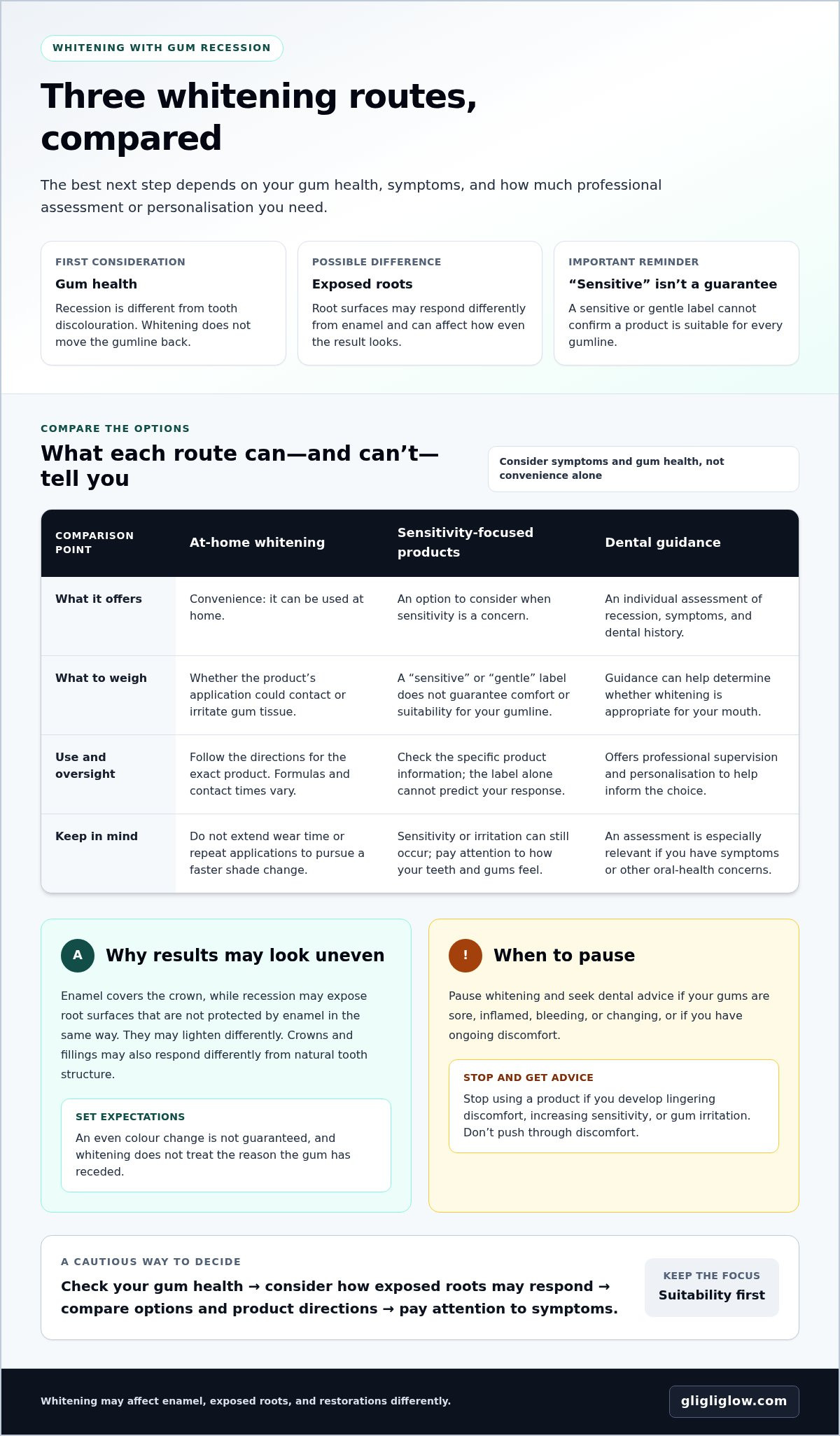
A cautious checklist before whitening with receding gums
A simple, step-by-step check can help you decide whether to pause, seek advice, or follow a product’s directions as written. With teeth whitening for people with receding gums, don’t let a shade goal rush the decision. Start with how your teeth and gums feel, then consider the product.
Which symptoms mean you should pause whitening?
Stop using a whitening product if you notice persistent or worsening sensitivity, gum irritation, bleeding, or pain. Mild discomfort that passes may not mean the same thing as symptoms that continue or return, but you can’t reliably identify the cause from the sensation alone. Don’t push through discomfort to finish a course.
Seek dental advice promptly if symptoms are severe, persistent, or unexplained, or if your gums are changing. A professional can assess your symptoms and help you decide what to do next.
How can you reduce avoidable irritation during use?
Before starting, read the directions and suitability warnings for the exact product you have. Apply strips, gel, or other products carefully, following label guidance about contact with gums and other soft tissues. Stick to the instructed contact time and frequency. Longer or repeated exposure isn’t a shortcut to a better result, and combining products may increase exposure in ways their instructions don’t address.
For general guidance on using a kit, see how to use a teeth whitening kit safely. Product-specific directions still take priority.
Quick checklist
- Stop and seek advice: persistent or worsening sensitivity, irritation, bleeding, pain, or other severe, persistent, or unexplained symptoms.
- Before use: notice how your mouth feels and read the specific product’s directions and warnings.
- During use: follow application steps, contact time, and frequency exactly. Don’t extend use or combine products unless the instructions and qualified advice support it.
- After use: reassess your comfort. If symptoms continue or return, stop and seek dental advice.
Ready to explore an at-home whitening option? Explore GLI GLI teeth whitening products after considering your symptoms and the directions for the product you choose.
How GLI GLI can fit into a more considered whitening routine
Once you’ve considered your gum health and any symptoms, an at-home whitening product may be an option to evaluate. GLI GLI offers an at-home whitening range, including the GLI GLI Teeth Whitening Kit and solutions developed for people mindful of tooth sensitivity. These products are for whitening, not for diagnosing, preventing, or reversing gum recession.
For teeth whitening for people with receding gums, a sensitivity-focused option may be relevant to compare, but it can’t tell you whether exposed root surfaces are suitable for whitening or guarantee a comfortable experience. Individual oral health matters. If you have bleeding, swelling, pain, or persistent sensitivity, pause and seek a dental assessment before starting or continuing.
What can a sensitivity-focused whitening option offer?
GLI GLI’s sensitive-teeth solutions are developed by dental experts. That may make them worth considering if sensitivity is on your mind, but it doesn’t establish that a particular product is right for every receding gumline. Check the product’s active ingredients, directions, contact time, and suitability warnings. Compare those details with your symptoms and dental history, and follow the specific label rather than assuming all whitening products are used the same way.
For broader context as you weigh your options, read this at-home teeth whitening kit guide. Use it to support your comparison, not as a substitute for an assessment if your gums or teeth are bothering you.
What is a sensible next step for your smile?
Keep the decision simple: pause if you have pain, bleeding, swelling, or sensitivity that persists or worsens. Seek dental advice if recession is new, changing, unexplained, or uncomfortable. If you aren’t experiencing concerning symptoms and are considering at-home whitening, review the product directions and warnings carefully before deciding whether to use it.
A whitening kit can’t assess the cause of recession or treat the gumline. Let your oral-health needs guide the timing, and stop if discomfort develops rather than increasing exposure or pushing through. When you’re ready to compare an at-home option, explore the GLI GLI Teeth Whitening Kit and other GLI GLI whitening products with your personal suitability and the label directions in mind. A thoughtful choice can be part of a brighter-smile routine without putting shade goals ahead of your comfort.
Choose a brighter-smile plan that puts gum health first
With teeth whitening for people with receding gums, the right next step depends on your symptoms and oral health, not simply the shade you’d like to reach. Exposed root surfaces may respond differently from enamel, so results can vary. If you have pain, bleeding, swelling, or sensitivity that persists or worsens, pause whitening and seek a dental assessment before choosing a product.
If you’re considering at-home whitening, review the product’s ingredients, directions, and warnings, and follow them exactly. A sensitivity-focused label may be useful to consider, but it can’t guarantee comfort or suitability for exposed roots.
GLI GLI’s at-home range includes whitening kits, gel refills, pens, and an LED device. Its sensitive-teeth solutions are developed by dental experts, but they don’t treat gum recession. Once you’ve considered your oral-health needs, explore the GLI GLI Teeth Whitening Kit as an option to evaluate.
A thoughtful pace is part of caring for your smile. Let comfort guide your next step, and give yourself room to make an informed choice that feels right for you. ✨
Frequently Asked Questions
Can you whiten your teeth if you have receding gums?
Yes, whitening may be possible, but suitability depends on your gum health, symptoms, and dental history. Recession can expose root surfaces that may be more sensitive and may not respond like enamel, so results can look uneven. If recession is new, worsening, painful, or accompanied by bleeding or swelling, pause whitening and seek a dental assessment first. Whitening products change tooth shade; they don’t treat gum recession.
Is teeth whitening safe for exposed tooth roots?
There’s no blanket answer: whitening may cause sensitivity or irritation when exposed root surfaces are involved. Those surfaces aren’t covered by enamel like the crown, so the product directions and your individual oral health matter. Seek dental guidance if roots are exposed, you already have sensitivity, or you’re unsure whether whitening is suitable. Stop using a product if discomfort continues or worsens.
Can whitening make receding gums worse?
Whitening isn’t a treatment for recession and shouldn’t be relied on to change the gumline. Whitening ingredients can irritate gum tissue, particularly if it’s already inflamed. Irritation doesn’t prove that recession has worsened, but it is a reason to stop and reassess. Avoid whitening if you have active gum disease or inflamed gums until a dental professional has advised you on next steps.
Which teeth whitening is best for sensitive teeth and receding gums?
There isn’t one best option for everyone with sensitivity and recession. A product labelled for sensitive teeth may be worth comparing, but that wording doesn’t guarantee comfort or suitability for exposed roots. Review its active ingredients, directions, contact time, and warnings. GLI GLI’s sensitive-teeth solutions are developed by dental experts, but personal oral health still matters. Seek dental guidance if sensitivity is persistent or recession is changing.
Should I ask a dentist before using whitening strips with receding gums?
It’s wise to seek dental guidance before using strips if you have receding gums, especially if the recession is new, worsening, painful, or unexplained. The American Dental Association recommends a professional dental examination before whitening to identify oral-health issues that may affect your decision. Pause and seek advice if you notice bleeding, swelling, persistent sensitivity, or visible root exposure. If you use strips, follow their product directions exactly.
What happens if whitening gel touches receding gums?
Whitening gel that contacts gum tissue may cause irritation or discomfort, though everyone’s response differs. Follow the product directions for application and what to do if gel reaches soft tissue. Don’t add more gel or extend use to chase faster results. Stop if you experience pain, bleeding, or irritation that persists or returns, and seek dental advice for severe or unexplained symptoms. Product instructions should guide any immediate response.


